Showing posts with label Italy. Show all posts

Tuesday, August 2, 2016

When Winging It is Wonderful: Modena

Somewhat spur of the moment, we decided to head down to Modena (accent after the first syllable, I just learned) with a couple of friends and do some Ferrari-driving and balsamic vinegar tasting. We hoped to squeeze in some wine tasting as well and were on the wait list for a highly touted restaurant, but neither of those things panned out. I can't be too bummed about it, because it ended up being a really fun day.

We hit the road shortly after 0800 and started heading South-ish. With good conversation and little traffic, the miles flew by. I suspect they went even faster because we made the other couple take charge of driving. Hah! Don't think we're total responsibility abstainers though, because we did chip in for tolls, which I think came out to something like 18 Euro for the round trip. It took just a little more than an hour and a half to get to Pit Lane, just south of Modena in the town of Maranello. I'd sent an inquiry the night before, but they were closed so we weren't sure if we'd be able to actually drive the cars or not, pending availability. We found ample parking right out front, and were promptly swept the opposite direction from a sweet-talking competitor. Because he was standing pretty much directly in front of Pit Lane, we assumed he worked there, and it took a few minutes before we realized he didn't. However, he assured us there was a bar and the two ladies could wait while the men did the driving. You have a bar, okay, I'm sold! Turns out, there was no bar, but there was a least a shaded outdoor seating area (and coffee vending machine) where I could wait.

Pricing for the test drive started at 70 euro for ten minutes and increased based on the model of car you chose and the length of driving time desired. Having little desire to drive one of those machines and no clue about the difference between the types of Ferrari available, I left all the deciding up to Tony, who ultimately chose to drive a California for 20 minutes. His pal hopped in the back seat and their co-pilot - after a brief demonstration of the paddle shifters - took the passenger side. They started up the video camera and took off. About half an hour later, they came back with big goofy grins on their faces, so I think they deemed it a successful outing. It must have been, because they sprung for a cd of the video and photos to take home. As it turns out, all of the driving was on streets and they had to contend with normal traffic, so they didn't get to go too terribly fast. Only 150 or 170 kph or something like that...(rolls eyes) And the route happened to go by a dog food factory, so I'm sure that was an awesome smell (carne for cani, said the co-pilot). But all-in-all, the gents seemed satisfied so it was a good choice. I do think we're going to have to make a return trip so they can test drive Lamborghinis later. You know, for scientific comparison.


We elected to skip the museum and head directly to lunch. We headed somewhat east of Modena to the small town of Rubbiara di Nonantola. We got a little concerned to be in such a tiny, residential area, and actually drove past the acetaia twice. On the second pass, we were going slow enough to see the signs and determine where to park, and we saw a few people sitting out in the back. They clearly saw us drive by and turn around, because by the time we parked and headed in, the older gentleman was standing outside the door to greet us. He shook all of our hands and introduced himself, and an English-speaking waiter appeared to help translate. My friend asked if they got our reservation, and the old man said they don't read their emails. Baffled, we started backpedaling and trying to ask about lunch, but the waiter started laughing and told us the old guy was joking. Ha ha, you got us! The older guy (I later learned his name was Italo, because I missed it during the introductions) then proceeded to tell us there were only two rules in his osteria. The first was: no cell phones allowed, to which we all promptly and happily agreed. The second was told to us more or less thusly: "No ordering. You eat what I bring you," to which we all promptly and happily started drooling all over ourselves and fighting for seats at the table. Just kidding, first we had to stop and lock our phones in some wooden cubbies. You thought Italo was joking about the no phones rule, huh? He wasn't. As the waiter led us to our seats, the cute little aproned nonna disappeared back to the kitchen.

We sat at a table for four, in a large covered patio surrounded by wisteria and I think boxwoods. Off to the side was a little swing (in the smoking area) and we had a nice view of a big backyard. The weather was perfect - sunny and clear, not too hot, with a slight breeze, and I was so happy we got to enjoy the meal outdoors. In short order, the waiter brought out a bottle of something white and bubbly, produced and bottled on site. To go with it, our first course was a delicate pasta stuffed with ricotta and spinach, which we were meant to drizzle with balsamic vinegar and Parmigiano cheese. We didn't fight over the last few pieces, but only because we knew there were more presumably equally delicious dishes coming. We switched to Lambrusco and had a very nice pasta with ragu for the second course. The main course was actually a platter containing balsamic chicken, guinea fowl with prosciutto, balsamic pickled onions, and fritatta (also drizzled with balsamic vinegar). We polished off another half bottle of Lambrusco, and then for dessert we had gelato drizzled with more balsamic vinegar. I couldn't tell if the gelato had a lemon flavor to it, or if the acidity in the vinegar lent a citrus flair to it, but either way it was delicious. Next our waiter brought out coffee and grappa - four kinds of grappa, to be exact. A traditional, a Lambrusco, a walnut, and a limoncino. I tasted the walnut and found it to taste like, well, walnut, with a decidedly coffee-like finish. It was fine, but I'm glad I just had a little sip as a little goes a long way. I had a shot of the limoncino, which really hit the spot after eating such a rich meal. I didn't try the Lambrusco grappa, but as we were walking away Tony left his shot on the table so I went ahead and downed it. Waste not, want not, right?

After the leisurely lunch, we joined a British couple on a tour of the acetaia. First we went to the large aging room and got an explanation of the process, and our eyes started watering from the acrid nature of the air. I noticed a confessional near the door and asked about it. Inside the confessional was a small flask and bottle, for the local priest. I guess that's one way to tithe! Next we went into the small aging room and learned a little about the Pedroni family history. They are in their 7th generation of making balsamic vinegar, though the family name can be traced much farther back. I asked about the family crest and learned it was created in the 1600s, when Leopold I (of Austria) made the family part of the nobility. Traditional Modena balsamic vinegar must age at least 12 years before it can be sold, and the Pedroni acetaia had 12-, 20-, and 40-year old vinegars for sale. The oldest cask in the small aging area dated back to the 1800s! Most of their aging is done in barrels of chestnut, though they also use mulberry, juniper, cherry and I think a few other varieties.
Photo from http://www.acetaiapedroni.it
After the tour, we went back to the greeting area/lobby for a vinegar tasting. First we tasted some balsamic-pear jam. I could probably eat half a jar of that stuff with a spoon and feel no regrets. Then we tasted their daily balsamic, the IGP which I think I preferred over the 12-year and 20-year stuff. Sadly, we did not taste the 40-year old vinegar. The family sells their wine and grappa (including a cherry grappa we didn't get to sample) along with the vinegar products, and some local honey. We paid 35 euro per person for the meal, tour, and tasting, and it was definitely worth it. You can learn more about the business and products here, and there's even a portion of the website dedicated to recipes: http://www.acetaiapedroni.it/

After lunch we headed to the Vinoteca Modena, recommended by our waiter Lucas. He told us it would be closed but if we knocked and said he sent us, they would open up for us. However, when we got there it looked really really closed, so we decided to head on home.

And by home, I mean we went to the neighborhood gelateria by our friends' house, and then walked across the street to the local butcher and picked up steaks and salsiccia. Then we went to THEIR home and had dinner and played a few games of LRC and dice bowling before heading to our house. For a trip we totally winged, it turned out beautifully.

Wednesday, March 9, 2016

Wine-Tasting in Valpolicella Region

I recently went wine-tasting with a couple of girlfriends from work. (I work! I have girlfriends from work! Whoa.) We made plans to carpool to the Valpolicella wine region, just north of Verona. It takes about an hour to get out there from where we live, but the drive went by very quickly despite horrendous rain. We arrived for our 10:00 am appointment at Antolini in the town of Marano just on time, and were met by a very cheerful Paolo. 

First, we went upstairs into the grape-drying area. When grapes are dried for wines like Amarone and Recioto, it is important to have a cool temperature and just the right humidity. Many wine-growers use lofts of barns or warehouses, and control the temperature and humidity with a mix of old-fashioned ways and modern technology. Unfortunately, we just missed the Amarone pressing by a couple of weeks so we didn't get to see (or smell) the drying grapes or witness the pressing. Allora. Next we went to the cellar, where juice was fermenting in a variety of barrels. Antolini uses a mix of sizes and materials - 225L, 500L, 1500L, etc. I was most surprised to find they use not only oak barrels, but also chestnut, cherry, and mulberry. The wood is sourced from Italy, Slovenia, and America. Next we went back to the tasting room - but only after Paolo pointed out some of the vines next to the driveway. With thick, gnarly trunks, the vines were 40-45 years old and trained with a horizontal spread much like a scarecrow on crossed sticks. I learned that often the oldest vines produce the favored grapes for Amarone and Ripasso.

The tasting line-up at Antolini
Next up: the tasting! We got to taste all of Antolini's wines with the exception of the 2013 Ripasso. So sad; I love Ripasso! Allora. The first wine we tasted was, of course, the Valpolicella Classico. It was very fruity, but a little young for me. Classico is not generally my favorite because they tend to be pretty bright and sometimes too acidic for my test. Next up, a pleasant surprise, the Corvina. This is only the second place I've ever seen Corvina bottled on its own and not part of a blend (Monte Tondo in Soave being the first), and it was really delicious and slightly peppery (one of my favorite things to taste in a red wine). This was the first vintage they tried it at Antolini, from 2013, and I think it was a very successful experiment. It was more medium-bodied and fruity, but not nearly as tart as the Classico, and a hint of the oak and maybe some almond smells came through. Next up was the TheoBroma Rosso Veronese, which is a blend of Cab Sav and Croatina. I'm pretty sure the Croatina grape is one that is only used in Italy. The TheoBroma was the most tannic and oaky of all the Antolini wines, and is not something I think I'd gravitate to but I bet my husband would really enjoy. Finally, the moment I was particularly looking forward to, a side-by-side comparison of their two Amarone wines: Moropio and Ca Coato. Both great! The Moropio is more intensely fruity and has an underlying minerality, whereas the Ca Coato was very soft and velvety. I think the Moropio was a little more dry and spicy and the Ca Coato was more fruity, with a pretty good undertone of vanilla and subtle caramel. I'd drink the Moropio with food and the Ca Coato on its own. MWAH! Delizioso. Last, we tasted the Recioto, a very typical dessert wine from this region. And by typical, I mean they have literally been producing this wine in this region for thousands of years, long before Amarone and Ripasso were produced. My main issue with dessert wines is that often they are syrupy and cloyingly sweet. The Recioto from Antolini? Not at all! It's pretty amazing to me the difference it makes when you stop the fermentation process early to produce a Recioto versus letting it go all the way to make an Amarone. Same grapes, same process to a certain point, but wildly different results. This particular Recioto I think could be dangerous, because you can barely taste the alcohol. It's light and refreshing and I'm pretty sure I could just drink it all day if I was in the mood. 

After tasting all the Antolini wines - and putting a nice dent in my pocketbook when I purchased lots of wine to bring home - we asked Paolo if he had any lunch recommendations for us. He said his favorite restaurant was still closed for the winter, and told us about his second-favorite place. He even called and made a reservation for us, and gave us business cards for both places, for whenever we go back to that part of the country. Talk about excellent customer service! Oh, and Antolini is the only winery we visited that did not charge us a tasting fee.

Since we still had a good bit of time before lunch, we decided to make an impromptu trip to Fratelli Vogadori. We called ahead to make sure they were open and let them know we were coming, but it turns out that was probably unnecessary as they only had a few other people in the giant tasting room. We found it pretty easily, though I did have to make a crazy-tight turn into their driveway (fine, I admit, I Austin Powersed my way in there). They have a nice big gravel lot with a great view of the valley below, and the tasting room maximizes that view with lots of glass windows. We sat down right in a corner and one of the three brothers came over to walk us through the tasting session, and set out a plate of bread and their house olive oil -from the trees we could see right underneath us through the windows! First, the Valpolicella Classico, which - no surprises here - was too tart for me. Next up, their Valpolicella Classico Superiore Ripasso, aka the Ripasso, which was dynamite. One of my top wines of the day. It smelled like raisins to me but had a hint of cinnamon and maybe some other baking-related smell I couldn't quite identify. We also got to taste both of their Amarone wines, so I got a bonus side-by-side tasting. The first was delicious - very strong vanilla and caramel smells. The second was also delicious, and one of the most distinct chocolate-smelling and tasting wines I've ever had. It was also not as tannic as the first one. One neat thing about the second Amarone, the Forlago, was that every few minutes the smell and taste really evolved. Old-timers say that you should open a bottle at least one hour ahead of time for every year of its age. Many people will open a bottle in the morning to enjoy after dinner, or even open it the night before. Amarone can also age very well in the bottle, so of course it will probably taste very different years down the line. We also inquired about a couple of other wines on the list, and Gaetano (I really hope that's the name of the correct brother) kindly opened a bottle of Raffaello for us. The Raffaello is named for their father, and has been in production for about a decade. I think it's basically an Amarone, but they classify it as a Rosso Veronese IGT, so I'm not sure. It's aged in cherry rather than oak, so maybe that's why. Very yummy wine! Were we done yet? No. There's more! I was so sad to pour out so much wine throughout the day, but as the driver I wanted to be very careful and safe. We also tasted their Recioto, which was slightly thicker than the one from Antolini, and a little sweeter. Still, not at all too heavy. But wait, there's more! Oh yes, there is. The dreaded Grappa. Now, those of you who know me know that I am generally not a fan of Grappa. I like the ones that are sweet and taste like a liquid Jolly Rancher, but traditional Grappa is gross, and the herbed ones I find flat-out disgusting. That said, I actually didn't mind their Amarone Grappa aged in barrique. I don't think I would seek it out, but if someone poured me a glass I wouldn't mind sitting and sipping it to be social, and I might actually enjoy it. 
The tasting line-up at Fratelli Vogadori
I read a bunch of reviews on Trip Advisor, and I was surprised by some of the negative critiques. We had a great experience, and a very relaxed chat with one of the owners. He was very knowledgeable and we talked in a fair amount of depth about the history of the region, methods of wine production, and distinct characteristics of each wine. He did have to get up a few times to attend to other things - after all, it's his business! - but that didn't detract from the experience whatsoever. He was clearly passionate about wine-making and proud to share that their winery is so environmentally friendly - no chemical fertilizers, no pesticide, etc. I can see how possibly the place could get very full during tourist season and people's experiences might not be so intimate, but I have zero complaints or reservations. Speaking of reservations, Fratelli Vogadori also has rooms for rent! Each room has its own bathroom and there's a shared kitchen. I'm seeing an overnight trip in my future! 

By this time, we were more than ready for lunch. We trekked on over to Osteria alla Pieve, in the town of San Pietro in Cariano. Paolo knows the owner and chef, and they knew exactly who we were when we walked in, and walked us straight to our little table in a corner - across from the wood-fire merrily crackling in a fireplace. We each ordered a little appetizer, some acqua naturale, and another bottle of wine. (I tasted the wine, a DOC Valpolicella from La Giaretta, but I didn't really drink any. It was pretty good with food.) We each got to taste the Monte Veronese fonduta (local cheese fondue), prosciutto praga (Prague ham) with pickled onions, and polenta with mushrooms and cheese, if my memory is correct. I ordered pasta with black truffles, and my friends ordered Amarone-marinated steak, with potatoes and salads. And we got to watch the steaks cook on the fire! Color me impressed, and color the steaks the perfect shade of pink. Yum yum. The restaurant also has a huge wine selection, including wines made by the owners. I wish we'd had more time to sit and savor (and let's be honest, try dessert), but we had to head across the valley to our last wine-tasting appointment at Le Bignele.
Four typical grape varietals of the Valpolicella Region
And by across the valley, I mean over the river and through the woods and along some twisty, curvy, narrow roads. I think my knuckles are still white from the experience. I've been to Le Bignele before and definitely remembered some narrow and winding roads, but this time we approached from the opposite direction. We turned on a gravel road and headed up a steep incline, and near the top we passed a couple of farmers loading a tractor. About fifteen yards past them, the road did an exceptionally sharp turn to the left and appeared to dead-end in their "driveway." I backed into a flat area (presumably used for loading and unloading tractors) and pointed back down the hill. My friend rolled down her window and proceeded to tell them we were lost and ask if they knew how to get to Le Bignele. They pointed and said we were only three hundred meters away, back up the hill behind us. Apparently the road did TWO s-turns and it was so steep and sharp that we couldn't see the second one. We thanked them and I backed into the same turnaround spot (thank goodness it was there, or I would have been completely screwed) and carried on. I had to do another Austin Powers back-and-forth turn to make the second bend, and then it got REALLY interesting. Imagine a nice dirt walking path. Now imagine that path with some intermittent patches gravel. And now imagine that walking path has stone walls on both sides. And now use your imagination to picture a charcoal gray 2013 Honda Accord squeezing down that path so tightly that the mirrors only had a couple inches of clearance. Then about a hundred yards down the lane, add in two concrete strips where the tires should go. Now picture me driving that Accord, scootched way forward in my seat and sitting high over the steering wheel, slowly creeping along that road and praying there aren't any sharp turns. That was how we approached the winery. I can feel my heart rate speeding up just writing about it! 

When we finally, mercifully, arrived at Le Bignele, Sylvia (the owners' daughter) was ready for us. We got out of the car and she greeted us. Then she said, "And who is the driver?" I raised my hand and she said, "I commend you. You just took the ancient road. It has been there a very, very long time. When you leave, be sure to go the other way." (Spoiler alert: I did. It was still narrow and windy, but not nearly so nerve-wracking.)

Inside the Bignele Cellar, photo from their website
After a brief tour of the steel tanks, cellar filled with barrels, and grape-drying area, we headed downstairs to the tasting area. We all promptly fell in love with a shelf full of "Olivia Pope Wine Glasses," and then sat around the table. (You can purchase the glasses here: Crate and Barrel Camille ) Before Sylvia poured our first glass, we were joined by a local Italian gentleman who came in to buy some Ripasso but stayed to taste the whole selection when he heard Sylvia was doing a session for us. It was a merry group. We tasted five wines at Le Bignele: a Rosso Veronese, a Classico Superiore, Ripasso, Amarone, and a Recioto. I enjoyed the first very much, and again was not a huge fan of the Classico. I can definitely identify a trend! The Ripasso was dry and fruity, and their Amarone remains one of my favorites. It's a little more delicate than some, but still has great cherry and vanilla flavors. Very well-balanced and drinkable. I think perhaps it's less of an occasion wine than some Amarone out there. The Recioto was the heaviest and sweetest of all the ones we tried that day, but not in a bad way. Syliva served it with chocolate chip biscotti and joked that if we wanted to live, we'd only eat store-bought cookies at her place and not anything she cooked. At that point we told her about asking her neighbors for directions, and she instantly knew who they were, and said the lady is a very good cook. We said we should all go to her house next and ask for more biscotti! Le Bignele normally charges a ten euro per person tasting fee, but it is waived when you purchase their wine. After we made our last purchases, we loaded up the car and hit the road. I definitely remembered to go the more traditional route instead of taking the ancient road home, and was much more relaxed for having made that decision.

Overall opinion: If you want to go tasting in Valpolicella country, you can't go wrong at any of these three places. All three experiences were personalized to us. I think Antolini was the easiest to find and Vogadori had the best view, but I felt most comfortable relaxing at Le Bignele, if any of those opinions factor into your decision. All of the wines seemed pretty characteristic - lots of fresh cherry and red fruits, vanilla, caramel, cinnamon, and chocolate. I think there's probably something to suit everyone's tastes.

Bonus: Here's a great, simple run-down of the different tires of Valpolicella wines: http://winefolly.com/review/valpolicella-wine-pyramid/

Monday, December 14, 2015

Bolzano Christmas Market & Archaeology Museum

Christmas markets are a thing in Europe, particularly in Germany and Austria, but Italy is known for having some great ones as well. Last year, due to a crazy combination of timing, school, Tony's work schedule, and our awesome vacation to Malta, we completely missed out on this entire phenomenon. First world problems, I know. This meant it was very high on my list this year. I thought I'd have more time, but it has a way of slipping away from me these days. Fortunately, we were able to jump on a group trip with Lucas (of Cooking With Lucas fame) and head to Bolzano - the largest and most famous Christmas market in Italy!

Mercatino di Natale, Bolzano Italy
In Italian, a Christmas market is a Mercatino di Natale. I learned that in Bolzano, in the Dolomites of the South Tyrol Province South of Austria, Germany is one of the official languages. It still trips me up to see signs in anything other than English, but as you venture closer to other countries or apparently, provinces with secondary languages, it's even stranger to see multilingual signs. My brain is getting very full of important words like gelato and formaggio, but I managed to make room for another phrase: Christkindlmärkte. Just don't ask me to pronounce it. I know another phrase but hadn't been able to put it to use yet: vin brûlé. That is Italian for mulled wine! (In German: gluhwein.) Never fear, I have now partaken of both the red and white varieties in an official setting! With a bonus tasting of hot apple cider with rum. Yum yum yum.  

Pretzel, speck, & cheese sandwich + Gluhwein

Man, I got started talking about food and drinks and totally distracted myself from where I was going in my story. I think I jumped ahead of myself a bit. Anyway, it took us a little more than two hours to get to Bolzano. I drowsed a bit on the bus, which isn't really surprising since I had nightmares the night before and also took two Benadrylls before we hit the road; better to sleep than have motion sickness! Plus, I have a sore ear and I thought the allergy medication might help relieve some of the pressure. Anyway, the drive seemed easy. I woke up somewhere East of Lake Garda (and recognized exactly where we were, BECAUSE I AM AN AWESOME ADVENTURER!) just in time to see a fantastic monastery built into the hillside. I expected the drive to be a very twisty-curvy one, with lots of up and downs, but it was all highway and pretty straight shooting. Our bus driver did an expert job backing the bus into a spot in a parking garage, and we set off in the freezing cold -2 degree weather (okay, fine, -2 degrees Celsius, but still) to find the Christmas market. We parked about five blocks away and just followed the crowd. The idea was to go to a microbrewery for lunch, but it ended up being really crowded so we settled for street food instead.First order of business: red vin brûlé and a pretzel sammich with cheese and speck. FYI: Speck is a cured meat similar to bacon or prosciutto, and is native to the Tyrol region. That was a darn good pretzel, the best I've had since Oktoberfest in Munich! (Dang. Please don't think I'm an asshole just for having some awesome adventures. After all, I had to wait fourteen months (and one really bad gas station quality pretzel) before experiencing pretzel bliss again.) Next up: that necessary evil, a public bathroom. Surprisingly, for the low price of 70 Euro cents, I went through a turnstile and marched right up to a clean, empty stall, and then washed my hands with soap and hot water. A+, Bolzano, top marks for bathroom quality. 

That right there is a nice steamy mug of gluhwein!

Miniature Train (Photo Credit: http://www.bolzano.net)
After that, we wandered around. The main event happens in Piazza Walther, anchored by the 14th century Assumption of Our Lady Cathedral, with smaller clumps of vendors in other piazzas and scattered throughout the streets of town. It was fairly crowded despite the chill, and it's a great place to people-watch even if you don't feel like buying anything. We saw lots of Christmas ornaments, from hand-carved and laser-cut wooden ones to delicate tatted lace to hand-painted bulbs. There were linens, candles, and lots of local meats and cheeses. We saw kids riding a miniature train - and miniature ponies! I think the horse owners as well as parents are very trusting; the parent would pay, some adult would help the kid onto the pony, and the owner would hand the reins over to the parents for a few minutes and the parent would then guide the animal up and down the street. Everywhere we went, you could find artisan bread and pretzels and sweets, plus did I mention the vin brûlé?! One of my friends had a white hot chocolate that looked delicious, and he said it was amazingly creamy in texture and just the right amount of sweet. I didn't partake of any hot chocolate, white or otherwise, but I did sample some delicious hand rolled truffles. Okay fine, I did more than sample. I gobbled up a traditional dark chocolate (fondente) and a coffee-flavored one, and Mr. Moneybags Husband was paying since I left my cash at home, and he bought two of each so we wouldn't even have to share! I'm pretty sure that's a testament to his generosity, and not selfishness of wanting his own truffle...We saw lots of vendors roasting chestnuts, and smelled some heavenly combination of cinnamon and vanilla and maybe nutmeg? that meant there were candied nuts for sale, too. There were gingerbread and sacher torts, too. Sacher torts are an Austrian chocolate cake with apricot jam or preserves, topped with dark chocolate frosting or ganache, and you can find them all over the Alps. In addition to the Christmas theme, we also saw some vendors with more common goods you'd see in any Italian outdoor market, namely fresh fruits, vegetables, and flowers. 

Hand-painted Ornament (Photo Credit: http://www.bolzano.net)
We already did our Christmas shopping for this year, and didn't really see anything that called to us for ourselves or for next year's gifts, so after some browsing (and some more of that delicious wine stuff) we proceeded to the South Tyrol Archaeology Museum. This museum was created specifically to house a pretty fantastic archaeological find: Ã–tzi – the Iceman. Otzi was discovered in 1991 and it turns out he lived about 5,000 years ago, sometime in between 3350 and 3100 BCE. The museum was very interesting and respectful, and the body is preserved in a special Han Solo cryogenic chamber - very cold, very humid, minus Han Solo - with a little window for viewing. You can read and hear all about the discovery and recovery, as well as view artifacts like his leggings, bearskin cap, and dagger. He also had specially made ember bags and tools. You can't see it, but you can hear all about the food remnants found in his stomach and intestines and cereal grains caught in the fibers of his clothing and pouches. And guess what: Otzi has 61 tattoos! They are positioned to correspond with modern acupuncture lines and were pretty certainly associated with some sort of therapeutic treatment. Brown-eyed Otzi had wavy, shoulder-length brown hair and a beard, was an inch shorter than me with the same size feet, probably weighed less than I do, and died when he was about 45 years old. There is an incredible life-size reproduction/recreation of what Otzi probably looked like, based on all sorts of fancy technology that I'm too ignorant to understand, much less sum up in a blog post. In short: it's way cool. 

Otzi the Iceman (Photo Credit: www.wync.org)
Otzi is important for many reasons; his was the first archaeological dig on a glacier, and as a result of his recovery and radiocarbon-dating methods, the timing of the Copper Age was revised by a thousand years, indicating it started much earlier than we previously thought. Otzi is also special because of the way he was preserved - naturally, in ice, rather than through artificial means or in peat. That means all of the organic materials haven't really been interfered with over time. Also, scientists and archaeologists didn't recognize signs at the initial time of recovery, but due to the nature of wounds, they were able to narrow down his cause of death somewhat. He was discovered on a known traverse/trade route. He had an arrowhead buried in his shoulder, which led to a big blood loss, fractures on his face and skull that occurred within 24 hours of his death, a significant gash on his hand indicating hand-to-hand combat, and a dislocated shoulder. Speculation is that he had some sort of an incident (perhaps a fight?) the day before he died and then went to an area where he felt safe. At some point, he ate a meal, and then within an hour of eating was shot with the arrow and died. The dislocated shoulder could have happened during that fall, or if he tried to rip the arrow from his own body (scientifically plausible). The arrowhead was found, but no remnants of the actual arrow itself, so somebody tried to pull it out at some point. Then, after he died, he must have been covered with snow and then ice very quickly, otherwise the elements and animals might have interfered with his preservation.

Whoa. So, um, yeah. Sorry to get all gruesome in the middle of a happy Christmas post. But it was fascinating!

Chocolate, Nut, & Marzipan Vendors at the Bolzano Christmas Market


My favorite alley of decorations! Giant pretzels!
Anyway, after we visited the museum, we did a few cloverleaf loops through the city and visited some of the smaller piazzas, one of which was specifically devoted to artisans. That square had wooden games, jewelry, felted wool clothes & ornaments, glassware, and all sorts of other cool handmade stuff. The town of Bolzano also has plenty of non-Christmas shopping available, everything from H&M and Aldo and Sephora to Armani and hand-cobbled shoes. I was quite impressed with the decorations around the entire city. Each street had hanging decorations, either lights or ornaments or some such. I saw innertubes twisted and painted like pretzels, bouncy balls painted like ornaments, singing angels, whispy white paper swirls, and lots of red and gold. Many of the trees were decorated with lights and ornaments too, including one giant potted olive tree with red boxes hung throughout. Even buildings were decked out with lights and 3D ornaments on the walls. All afternoon we were pleasantly taunted (if such a phrase isn't an oxymoron) by whispers of live brass music. It was hard to pin down a location or even a direction for the music, but we finally found it coming from a third-story balcony. The song they were playing when we honed in on the band? Feliz Navidad. Because of course.

Hopfen & Co. Brewery. Go there.
Around 3pm, we made our way to the Bozner Bier Hopfen & Co Brewery. It's in an 800-year old building and features Tyrolean and Italian cuisine, plus of course beer! (Birra in Italian, Bier in German, see why my brain is so fulllll?) Still stuffed from my pretzel sandwich, I settled for a radler and an endive salad with black olives, sundried tomatoes, and goat cheese. I was not disappointed. Tony went for a dark beer, a dunkel, and goulash with bacon beer dumplings. He loved the lager, which even I enjoyed despite not generally being a fan of dark beers, and REALLY liked the goulash. The bacon beer dumplings were a little heavy, though tasty. We sat and visited with a few of our friends, and then we split the vanilla gelato with hot raspberry sauce. And the angels rejoiced. I don't know what kind of witchcraft went into the creation of that ice cream or the sauce, but it was amazing! If I ever go back to Bolzano, I would eat there again in a heartbeat.

We spent a few final minutes meandering through town as we made our way back to the bus, snapping pictures and purchasing our truffles, and then headed home. I hereby deem our first Christmas market outing a tremendous success!
Yummy, yummy chocolate! Bonus tidbit: 'Chiave' is Italian for 'key'

Tuesday, September 22, 2015

Palio #2: Monselice

My aunt recently came to visit from South Africa, and I wanted to try to give her a fantastic and authentic Italian experience in the limited free time we shared together. That's how we found ourselves taking a short road trip with another friend to the town of Monselice to experience their horse race called "quintana." Giostra della Quintana is, in short, a joust. Of course, we had no clue what we were in for when we hit the road, but that didn't stop us from having a wonderful day at the track and wandering around the town.

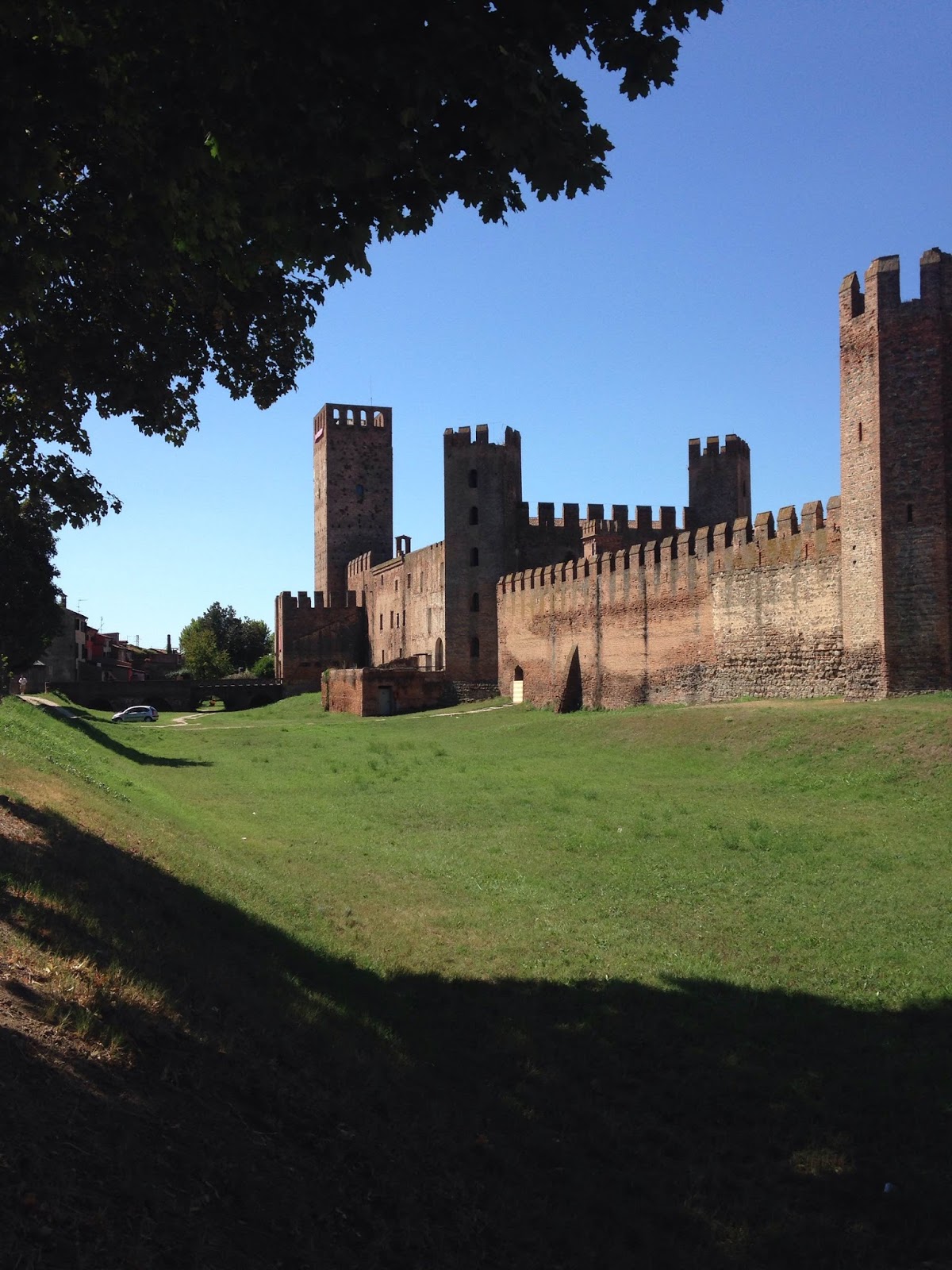
Monselice Castello
It took about 40-45 minutes to get to Monselice from Vicenza; it was an easy drive and tolls were less than five euro each way. You can see the hill with its tower before you can see the town proper, so we definitely knew we were heading the right direction long before we got there. Sometimes driving in Italy can be stressful, so affirmations like giant, easily-identifiable hills are a boon. We didn't exactly know where to go in town, so the vague plan was to arrive, look for the town center, and park somewhere close. That's generally a good plan, provided you don't accidentally stray into a residents only traffic zone, and it worked for us. When we arrived, we saw lots of people walking about in medieval costumes, so we knew we were close to the right spot. We started venturing away from that area of town and quickly found ourselves along a river in a residential neighborhood, so we stopped and asked for directions from a local. Twice. Thank goodness my aunt speaks better Italian than I do! We ended up just nabbing a great parking spot (for free!) along the river, and walking five or ten minutes into town, following the general flow of foot traffic.

Outside the Pub Enoteca Il Castello
One of the first things we saw once we walked into the town was a piazza, and bordering the piazza was a tower, clock, castle, and tourist information office. Bingo! We popped into the tourist office to obtain directions to the horse race and determine if there was anything else interesting or worthwhile to see while we were in town. I have no idea why more people don't know of this city, because it is home to a fantastically refurbished castle dating back to the 11th century, a pilgrimage of seven churches, two towers, and at least one really great restaurant. (There are probably more delicious restaurants, but we liked this one so much we ate there for lunch and came back for dinner!) We scoped out the castle tour schedule and then hit up the Pub/Enoteca Il Castello for lunch. And why is it called Pub/Enoteca Il Castello, you  might ask? Because it is located directly under the castle, has a secret passage connecting to the castle, and is owned by the city. A wonderful lady named Sabrina co-manages it with her husband. The inside is decorated with art, statues, pottery, and weaponry and the outside features a wonderful courtyard and seasonal flowers. Of course, since it was so nice we chose to sit a fuori, outside. We were intrigued by their extremely well-priced wine list, which is broken down by region and features some very local varietals, and asked about the possibility of a wine-tasting. The pub was slammed for lunch (always a good sign) so they suggested we come back in the early evening if we wanted to do that. Spoiler alert: we did. Two of us chose to have papardelle with wild boar ragu, and my aunt had crepes stuffed with ricotta and mushrooms. I drank a spritz and the others enjoyed some Prosecco, and then we were off to the races!

We walked for 10-15 minutes through the town to the foot of the hill, where we paid ten euro and sat in the bleachers with our backs to the sun to enjoy the spectacle. We had to pass through a gaggle of folks in costume to purchase our tickets, so we knew there would be a parade to kick everything off. Knowing Italy, we didn't think they would start on time, but they actually started five minutes early! Each of the nine communes of Monselice is represented by an animal or other symbol, and has its own colors. A representative troop from each commune marched in, accompanied by drums and/or buglers, and took their places in the opposite bleachers. They must have been broiling, what with all the velvet and brocade and facing directly into the sun! Unfortunately, the racing took for-eh-ver to start because various possibly important people needed to give welcome speeches. And then a cute kid read a presumably cute poem. I picked out a stanza about each commune, praising their speed, agility, horses, pretty colors, etc. People clapped. It was nice. More speeches. Blah blah blobbity blah, get to the good stuff! Finally, after no kidding an hour, the announcer started introducing the horses and riders and explaining the race.

A rider uses his joust to spear a suspended ring
Each commune had two riders, for a total of 18. I know this because all eighteen of them were introduced one at a time and each completed a lap around the track. See note above re: for-eh-ver. They would be pitted against each other two at a time with the task of spearing three impossibly small orange rings while racing around the track. Each rider would enter his respective outer side of the track when a two-minute warning bell rang. When that bell sounded, the competitors had two minutes to collect their spears, enter the inner track ring, and take position. They got a 30-second warning and a 5-second warning. Once the five-second warning sounded, they could begin racing the horses, but they couldn't cross the starting line with the rings until the official start bell sounded. We only saw one false start, which I thought was pretty impressive. The riders did one full lap before starting to collect their rings on the end of their jousting spear, and the rider who got three rings before the other won the heat. I think we stayed for five races, and the times ranged from 52-56 seconds, so you can understand the dirt track was not all that large. After each race a team of men wearing blue jeans, white button-down shirts, and baseball caps came out to rake the track, especially in the curves where we saw more than one horse stumble, but once everything kicked off there was a race every 5-6 minutes. So if you ever want to attend this event, know that you can pretty much skip the first hour and not miss much, but once it starts things move fairly quickly. Still, with so many riders it could take a couple hours to finish all the racing. This event was not nearly as big as the Palio of Montagnana, but equally well-organized. I'm glad I got to experience the two different styles of racing, and would recommend them both to anyone. Both events were very kid-friendly, too.

Because of our desire to see more of the town (and the fact that bleachers just aren't very comfortable), we left after only a few races. We headed back to the tourist shop to steal some of their very pretty brochures and then went to the Castello of Monselice, sometimes called the Castello Cini after one of its modern owners. We paid eight euro for an hour-long tour, and lucked out because we, along with one very lovely Canadian lady, wound up on an English-speaking tour for us instead of stuck with a group of 30 Italian-speakers. So we basically got a private tour of one of the most beautifully renovated castles I've ever seen, and our guide was exceptionally knowledgeable. It turns out he is an Italian who works for an American company out of Verona, and only works in Monselice on the weekends after putting in a regular five-day workweek. Art is his passion, and he joked about there not being much money in art, allora. For every question we asked, he was able to give us a detailed answer, and I was really impressed with his kindness and professionalism even though we could see he was just about dead on his feet. (At the end of the tour, our Canadian friend told him to start a six-day work schedule and take some time off.)

The castle consists of three main buildings (plus the bonus pub on the street below), connected but built across the span of several centuries. Unfortunately, the castle was bombed, left in shambles, and abandoned for a significant period of time so much of the layout, room purposing, and furnishing is speculation. That did not deter from the experience whatsoever. The first building we entered was set up as a weapons museum, and we learned one of the first rooms was likely used as sort of an armory and mudroom for local soldiers, who apparently had a crappy life back in the teen-hundreds. Poor blokes. We learned a lot about crossbows and suits of armor before moving on. We breezed through a courtyard and then walked up some stairs and then a ramp to the [European] first floor. As it turns out, the ramp was so visitors could ride their horses directly to the guest quarters and living space, hand off their animals to servants to be stabled, and enter the house without bothering with the peons on the ground floor. We weren't allowed to take pictures of the interior, and I was a good girl and followed the rules, but let me just tell you this place was stunning. There were tapestries on the walls, giant windows, tiny beds, heavy cupboards and wardrobes, and beautiful examples of glass, pottery, and other art. We also learned about some special chimneys very specific to not just the region, but this town. I commented earlier in the tour that I thought it was unusual to see so many round chimneys, and only one that was squared-off. Turns out the round chimneys housed smaller regular chimneys underneath, with a void in between. In medieval times, residents filled that void with sand, to retain the heat from the fireplace even once the fire was out. Brilliant! 

View from the upper courtyard in the Monselice Castello
Upper Courtyard in the Monselice Castello
After visiting the upper floors, we made our way across the courtyard to one of the other sections of the castle. It housed a chapel and a room with a hearth so enormous that historians think it was probably a kitchen. However, an alternate theory is that it was used as a forge for weaponry, considering the castle's defensive history. Nothing in that room was younger than 500 years old. Mind: boggled. The castle was owned by the town but now I understand it is owned by a regional museum authority or some such. Interestingly, 58% of the world heritage sites are located in Italy. Our guide carped that because Italians are surrounded by so much beauty and history, they have become complacent about maintaining them and delinquent in advertising them. Hence me stumbling across such surprises when I randomly venture out for the day. Why does no one know about these places? They are amazing! Anyway, rant over, tour pretty much over.

One of the seven chapels
After the tour, we continued walking uphill and peeked at the grounds of a private villa and into the Church of San Giustinia (St. Justina) which is also known as the Old Cathedral of Monselice. Continuing uphill, we walked past the Santuario Giubilare della Siete Chiese, or the Jubilee Shrine of the Seven Churches. There are seven chapels built into the hill, each one representing one of the major basilicas of Rome. They were constructed in the 1600s after a papal dispensation which basically said that a pilgrimage to these chapels was the same, and thus worthy of the same indulgences as a visit to the basilicas of Rome. Pretty good deal considering the status of travel in those days and the distance to Rome from the town. Each little church has a painting of its counterpart in Rome, and the seventh church also houses some pretty important and macabre relics. The seventh church is adjacent to another villa, across from which lead two sets of stairs. The first steps lead to an arched wall, and there were many people (mostly young folks) hanging out on the wall and steps enjoying the weather and the view of the town below. The second set of steps lead to the top of the Colle della Rocca, where there's another defensive tower. You can walk up there and climb the tower, but they let in the last visitors at 1800 and we got there around 1810. Boo. Oh well, we still enjoyed the walk and view. 


After scoping out the santuario, we headed back down the hill. We were thinking of doing wine tasting and having munchies at the castle Pub/Enoteca again, but were all pretty hungry so decided to have dinner as well. The establishment was far quieter than on our first visit, and we snagged a primo table outside. We started off by tasting a Serprino and a frizzante rose; I enjoyed the rose more and the other ladies preferred the Serprino, and they both worked out nicely with our meat and cheese platters. We decided to skip the whites and go straight for dinner and reds. For dinner, I ordered gnocchi with duck ragu, my aunt ordered veal ossobucco, and my friend ordered boar goulash with polenta. I think we were all very happy with our choices (I definitely was!) but my friend said the goulash tasted exactly the same as the boar ragu from our papardelle lunch. Still delicious, but basically the same meal only with polenta instead of noodles. Allora. We tasted a Merlot, a Merlot blend, a Rosso Riserva, and a Valpolicella. We all preferred different wines, and my favorite (surprise surprise) was the Valpolicella. I also got some tiramisu for dessert, and it was probably the lightest and fluffiest I've had since I moved to Italy. I ogled some of the other plates and desserts as they came out of the kitchen, and they all looked fantastic. Maybe next time I will order the mushroom and pumpkin lasagna, because I got a waft of it and it smelled delicious.

Another great adventure for the record books. Next time, I will climb to the tower when it's open, properly look inside each of the chapels, and do some more exploring around the town. I'll probably eat at the same restaurant though. Why try a new place when I've got a winner with unexplored menu options, amiright?

***

Here are some more pictures from the interior of the castle, which I did not take since I'm not allowed. Here is the original source: Monselice Castello
Armory Museum in the Monselice Castello

Interior room of the Monselice Castello

Interior Room and Chimney in the Monselice Castello


Montagnana Medieval Fest and Palio

Last year, on the weekend of my birthday I went to the historic Venice Regatta with a mixed group of new and old friends. We wandered around the city and then staked out prime real estate on one of the canals to watch the gondola races. My friends surprised me with a little fruit tart to celebrate, and they even remembered to bring/light a candle and sang to me! I was really touched.

This year was just as nice. The actual day of my birthday, I went to a friend's house and made a pot of jambalaya. If you know me,  you know that is probably my number one comfort food. Cooking it and eating it and sharing it with friends are all pretty much guaranteed to make me happy. I walked in to find a "Happy Birthday" banner, and for dessert they treated me to a delicious strawberry mousse dessert with balls of white chocolate on top to decorate. Heh, balls. I tell you, Italians have cornered the market on coffee and desserts: the coffee is dark and delicious and the desserts aren't tooth-cloyingly sweet. We played a few games and drank a fair amount of wine, and it was the perfect low-key evening.

The next day, a Sunday, I met one of my old friends (who I considered a new friend last year) and another new friend, and we carpooled to the beautiful city of Montagnana to experience its medieval market, parade, and palio. The definition of "il palio" is a banner or cloth awarded to the winner of a certain competition. However, over time the term has been associated so strongly with traditional horse races that in common usage, Palio will generally be used to refer to the race itself. If you've seen the James Bond film "Quantum of Solace" (with Daniel Craig, who is my favorite Bond) then you might remember the opening scene which featured a horse race in Siena. That is the holy grail of Palios and is uber expensive even for horrible standing-room-only space. The horses and their bareback riders, proudly representing their neighborhoods, race around the main town square with crowds on either side, and they make hairpin turns and it's all very exciting and intense. 

Instead of forking out the big bucks to stand outside all day and fight crowds for smelly port-a-potties, we decided to experience what I call "Palio Light." I'd never been to Montagnana, but when we heard they had an entire medieval festival featuring a palio, we decided to make it happen. I understand ten communities participate in this palio every year, and I believe Montagnana always plays host, probably because they have such a fantastic venue. Montagnana is only about 45 minutes away, and it's another gem of a city. It has a very well-preserved wall and castle that you can't miss when driving into the town, and seemed very clean. When I first heard we would be moving to Italy, that's the kind of town I envisioned, and it did not disappoint. Well, other than signage. We easily found a parking spot but there were no signs toward the parade or palio. We did ask someone and got the scoop, and as it turns out it was pretty obvious in the end so we didn't need signs after all. Still, it would have been nice to eliminate some of the uncertainty from the get-go.

Once you enter the historic part of the town, there's a small square but you're basically forced onto streets which all lead to the main plaza in front of (surprise) a large church. There were vendors lining the square, and there were a bunch of games set up for kids in the center. Stilts, pillow jousts, bean bag toss, etc. We walked the length of the main street and turned around to explore all the vendors and the square a bit more. When we learned the parade would circle the plaza before continuing down the main drag, we decided to sit and have appetizers and aperitivi. We thought we only had a few minutes before the parade began, and we saw a nearly continuous stream of people in medieval costumes streaming by, but as it turns out we had to wait a little more than an hour. The website said the parade began at 2 and the horse race would start at 3, but the times were off by an hour. Oh darn, sitting at an outdoor cafe in a beautiful cobblestoned plaza and people-watching while sipping cocktails, how awful. 


We really lucked out with our seats. There was a very kind American woman one table over, and we eavesdropped as she explained to another tourist about the parade route and horse race. She noticed us listening and we chatted for a few minutes about the various activities of the day. When the parade started, we had a fantastic view of all the participants as they walked down the last street of the plaza; they turned back onto the main drag right in front of us with the church serving as a backdrop. Their organization really impressed us (again, except for lack of signage and the confusion about start times). The parade kicked off right at 3, and they did a good job of separating the drum and bugle groups from each other by putting flag twirlers, townspeople, and horse riders in between them. There was even a group of monks and someone wearing a pope costume. Okay fine, it may have been a bishop or cardinal but he still wore a very tall and fancy hat and waved with a graceful benediction. He even stopped to bless some children, so I'm thinking this might have been an actual group of churchpeople. We saw donkeys and goats, men in stockades whose arms must have been very tired by the end of the parade, carts full of children which reminded me of clown cars, bakers, florists, and a group of camp followers who dressed pretty provocatively, if you catch my drift. Once the parade passed us, we all followed it outside the wall to what I suppose used to be a moat. 


For nine euro, you could sit on the moat embankment and have your back to the castle wall. For thirteen euro you could have an undesignated seat in the bleachers with your back to the road. We paid the extra four euros for bleacher seating, which was probably a good call since we didn't have a blanket to sit on or anything, and we mostly had our backs to the sun. We wound up at the far end of the moat and got to watch the tail end of the parade again as all the marchers had to make a giant cloverleaf loop to enter the moat and march to their spots. There was a pretty good delay between the end of the parade and the beginning of the races, but it wasn't a big deal. We were warned that there would be many false starts once the horse racing started, and when we saw the course we understood why. The "track" was a long and very skinny oval, requiring the horses to make tight turns in the corners. The jockeys all ride bareback, and there are no starting gates and no ground crew to help place the horses in starting position. Basically they all approach an invisible line and when they're all lined up and facing the correct position, the race starts. We understood there would be two heats of five horses, with the top three winners competing against each other in a third heat. Each race consisted of two laps, and we were far from the grandstand but directly across from the post where the horses make their last turn. The horses and riders entered the moat at the first post and completed a short lap. At this point, the three of us oohed and ahhed over the horses and jockeys, and picked a pony for which to cheer. My horse was one of the first ones out, and he seemed pretty spirited, which is why I picked him to root for, plus he was trimmed in beautiful forest green. After many false starts, the horses were finally off! 

The races happened very quickly. And on the first lap, two of the jockeys fell off their horses right in front of us! I didn't see the whole thing happen, but I think coming out of the turn they may have bumped into each other a little bit. One of the jockeys popped up and hopped over the fence very quickly in order to get out of the way of the other horses, but the other one was pretty slow to recover. He did eventually get up and move out of the way though, so I don't think he was hurt very badly, fortunately. The two riderless horses continued racing! By the time that jockey was up and moving, the horses were back for their final turn. My horse was in the lead, but it was a close race! We couldn't really see the finish line, and I'm pretty sure my guy won, but it was definitely a close finish. He may have given up the lead at the last second, or he may have just slowed down after crossing the finish "line" in order to make the turn for his victory lap. Either way, it was very exciting.


It wasn't long before the next race started, and it was carried out in much the same fashion as the first one. A jockey fell at the far end of the course on the last lap, and he had to be escorted out by ambulance. I hope he's alright. His horse kept running in circles until finally someone came out to catch and calm it. 

After the first two palio heats, there was a break so the horses and riders could all rest up a bit. During this time, there were some more festivities to watch. There was a funny sort of foot race where a bunch of guys representing the communities lined up on the track just the same as the horses, and they complete one lap, barefoot and carrying colorful banners. The dude with the green banner came in first, and his cheering squad went wild. I'm pretty sure he earned some very intense bragging rights. Next, many of the drum and bugle groups marched back onto the field and there was a pretty epic flag-twirling display. Each group was showing off simultaneously and while the drum beats were all in the same tempo, there were various musical flourishes happening up and down the field. We had a great view of three groups, and a pretty good view of two more, but have no clue what happened at the far end of the moat. Who cares, the groups in front of us were great! One group put a little kid out front for a big solo from the get-go, and that eight-year old kid rocked it. I kind of love how men in Italy are unashamed to twirl flags, and it is a very serious activity. Meanwhile, the group in front of us sent out a group of guys for flag tossing and choreographed double-flag twirling. Then another fellow stepped out to twirl and toss four flags at once. Trust me, it was very impressive.

We decided not to wait for the last race, so we skipped out after the drum and flag show was over. I feel like I experienced a true palio, and I didn't have to fight the crowds or pay exorbitant sums of money to do it, either. I will definitely look for this event next year and mark it on my calendar. Meanwhile, I hear there's another Palio in Monselice on September 20th. My aunt is in town and I think I will try to convince her to come check it out with me. [Obviously I did not post this before September 20th. Spoiler alert: we went to Monselice and it was fantastic. Expect a blog post about it soon-ish.]

P.S. This is definitely a kid-friendly event, so if you're on the fence worrying about your little ones, you should go!