Showing posts with label Food. Show all posts

Tuesday, August 2, 2016

When Winging It is Wonderful: Modena

Somewhat spur of the moment, we decided to head down to Modena (accent after the first syllable, I just learned) with a couple of friends and do some Ferrari-driving and balsamic vinegar tasting. We hoped to squeeze in some wine tasting as well and were on the wait list for a highly touted restaurant, but neither of those things panned out. I can't be too bummed about it, because it ended up being a really fun day.

We hit the road shortly after 0800 and started heading South-ish. With good conversation and little traffic, the miles flew by. I suspect they went even faster because we made the other couple take charge of driving. Hah! Don't think we're total responsibility abstainers though, because we did chip in for tolls, which I think came out to something like 18 Euro for the round trip. It took just a little more than an hour and a half to get to Pit Lane, just south of Modena in the town of Maranello. I'd sent an inquiry the night before, but they were closed so we weren't sure if we'd be able to actually drive the cars or not, pending availability. We found ample parking right out front, and were promptly swept the opposite direction from a sweet-talking competitor. Because he was standing pretty much directly in front of Pit Lane, we assumed he worked there, and it took a few minutes before we realized he didn't. However, he assured us there was a bar and the two ladies could wait while the men did the driving. You have a bar, okay, I'm sold! Turns out, there was no bar, but there was a least a shaded outdoor seating area (and coffee vending machine) where I could wait.

Pricing for the test drive started at 70 euro for ten minutes and increased based on the model of car you chose and the length of driving time desired. Having little desire to drive one of those machines and no clue about the difference between the types of Ferrari available, I left all the deciding up to Tony, who ultimately chose to drive a California for 20 minutes. His pal hopped in the back seat and their co-pilot - after a brief demonstration of the paddle shifters - took the passenger side. They started up the video camera and took off. About half an hour later, they came back with big goofy grins on their faces, so I think they deemed it a successful outing. It must have been, because they sprung for a cd of the video and photos to take home. As it turns out, all of the driving was on streets and they had to contend with normal traffic, so they didn't get to go too terribly fast. Only 150 or 170 kph or something like that...(rolls eyes) And the route happened to go by a dog food factory, so I'm sure that was an awesome smell (carne for cani, said the co-pilot). But all-in-all, the gents seemed satisfied so it was a good choice. I do think we're going to have to make a return trip so they can test drive Lamborghinis later. You know, for scientific comparison.


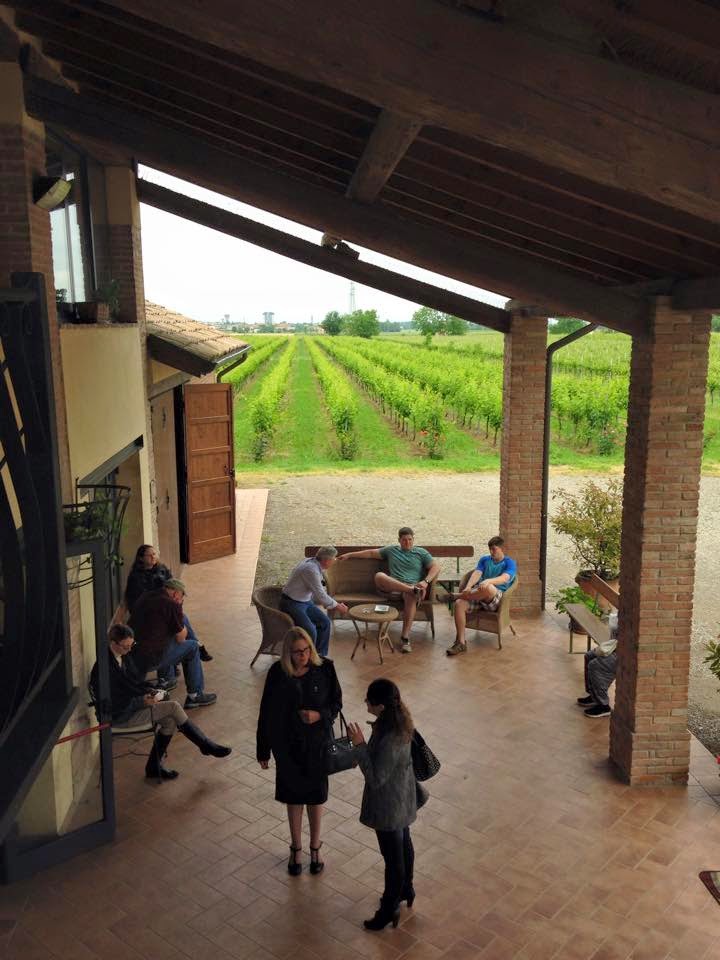
We elected to skip the museum and head directly to lunch. We headed somewhat east of Modena to the small town of Rubbiara di Nonantola. We got a little concerned to be in such a tiny, residential area, and actually drove past the acetaia twice. On the second pass, we were going slow enough to see the signs and determine where to park, and we saw a few people sitting out in the back. They clearly saw us drive by and turn around, because by the time we parked and headed in, the older gentleman was standing outside the door to greet us. He shook all of our hands and introduced himself, and an English-speaking waiter appeared to help translate. My friend asked if they got our reservation, and the old man said they don't read their emails. Baffled, we started backpedaling and trying to ask about lunch, but the waiter started laughing and told us the old guy was joking. Ha ha, you got us! The older guy (I later learned his name was Italo, because I missed it during the introductions) then proceeded to tell us there were only two rules in his osteria. The first was: no cell phones allowed, to which we all promptly and happily agreed. The second was told to us more or less thusly: "No ordering. You eat what I bring you," to which we all promptly and happily started drooling all over ourselves and fighting for seats at the table. Just kidding, first we had to stop and lock our phones in some wooden cubbies. You thought Italo was joking about the no phones rule, huh? He wasn't. As the waiter led us to our seats, the cute little aproned nonna disappeared back to the kitchen.

We sat at a table for four, in a large covered patio surrounded by wisteria and I think boxwoods. Off to the side was a little swing (in the smoking area) and we had a nice view of a big backyard. The weather was perfect - sunny and clear, not too hot, with a slight breeze, and I was so happy we got to enjoy the meal outdoors. In short order, the waiter brought out a bottle of something white and bubbly, produced and bottled on site. To go with it, our first course was a delicate pasta stuffed with ricotta and spinach, which we were meant to drizzle with balsamic vinegar and Parmigiano cheese. We didn't fight over the last few pieces, but only because we knew there were more presumably equally delicious dishes coming. We switched to Lambrusco and had a very nice pasta with ragu for the second course. The main course was actually a platter containing balsamic chicken, guinea fowl with prosciutto, balsamic pickled onions, and fritatta (also drizzled with balsamic vinegar). We polished off another half bottle of Lambrusco, and then for dessert we had gelato drizzled with more balsamic vinegar. I couldn't tell if the gelato had a lemon flavor to it, or if the acidity in the vinegar lent a citrus flair to it, but either way it was delicious. Next our waiter brought out coffee and grappa - four kinds of grappa, to be exact. A traditional, a Lambrusco, a walnut, and a limoncino. I tasted the walnut and found it to taste like, well, walnut, with a decidedly coffee-like finish. It was fine, but I'm glad I just had a little sip as a little goes a long way. I had a shot of the limoncino, which really hit the spot after eating such a rich meal. I didn't try the Lambrusco grappa, but as we were walking away Tony left his shot on the table so I went ahead and downed it. Waste not, want not, right?

After the leisurely lunch, we joined a British couple on a tour of the acetaia. First we went to the large aging room and got an explanation of the process, and our eyes started watering from the acrid nature of the air. I noticed a confessional near the door and asked about it. Inside the confessional was a small flask and bottle, for the local priest. I guess that's one way to tithe! Next we went into the small aging room and learned a little about the Pedroni family history. They are in their 7th generation of making balsamic vinegar, though the family name can be traced much farther back. I asked about the family crest and learned it was created in the 1600s, when Leopold I (of Austria) made the family part of the nobility. Traditional Modena balsamic vinegar must age at least 12 years before it can be sold, and the Pedroni acetaia had 12-, 20-, and 40-year old vinegars for sale. The oldest cask in the small aging area dated back to the 1800s! Most of their aging is done in barrels of chestnut, though they also use mulberry, juniper, cherry and I think a few other varieties.
Photo from http://www.acetaiapedroni.it
After the tour, we went back to the greeting area/lobby for a vinegar tasting. First we tasted some balsamic-pear jam. I could probably eat half a jar of that stuff with a spoon and feel no regrets. Then we tasted their daily balsamic, the IGP which I think I preferred over the 12-year and 20-year stuff. Sadly, we did not taste the 40-year old vinegar. The family sells their wine and grappa (including a cherry grappa we didn't get to sample) along with the vinegar products, and some local honey. We paid 35 euro per person for the meal, tour, and tasting, and it was definitely worth it. You can learn more about the business and products here, and there's even a portion of the website dedicated to recipes: http://www.acetaiapedroni.it/

After lunch we headed to the Vinoteca Modena, recommended by our waiter Lucas. He told us it would be closed but if we knocked and said he sent us, they would open up for us. However, when we got there it looked really really closed, so we decided to head on home.

And by home, I mean we went to the neighborhood gelateria by our friends' house, and then walked across the street to the local butcher and picked up steaks and salsiccia. Then we went to THEIR home and had dinner and played a few games of LRC and dice bowling before heading to our house. For a trip we totally winged, it turned out beautifully.

Wednesday, April 6, 2016

Kaiserslautern, Germany: KTown for the Win!

I recently had the opportunity to travel to Kaiserslautern, Germany for two weeks of work-related training. I've been to Germany once or twice before, but until this trip never had any real time to spend in the country. I stayed fairly busy from 0800-1600, but after that I had free time whenever there weren't work dinners to attend. And for the record, I am not normally a fan of "mandatory morale" functions, but I have such a fantastic group of co-workers who also happen to have excellent taste in food, so these outings were never a burden!

The flowers in Germany knew it was springtime, but someone forgot to notify the sun. I think if I'd stayed another week, I would have seen many more buds and blooms on the trees, but it was still a little gray and dreary when I was there. One of my favorite weather adjectives is "Seattle-ish" and if you've ever lived there, you know exactly what I mean. It only really rained once or twice in two weeks, but that's about how many days of sunshine we had, too. Mostly it was just a bit overcast, cool but not cold enough to be uncomfortable. 

When I arrived, there was some sort of street fair going on right outside my hotel. I stayed at the SAKS, which straddles the line between new and old Kaiserslautern. It's a great location for walking and exploring, and happens to be situated right on a plaza. After I unpacked my bag, I wandered outside for some exploring. At first I didn't see anything out of the ordinary - roasted nuts, carousel, lavender soaps. And then I saw my first pretzel! Have I mentioned that I am a fan of pretzels? I can be a bit leery though, as I had both the best and the worst pretzel of my life on the same day in Munich, about two blocks away from each other, which just emphasizes that one just never knows. I did a little pretzel research (by this I mean that I both ate a lot of pretzels in the name of "research" but also did some Googling and lots of reading, not that I went to a library or searched specifically for scholarly articles on pretzels, because, duh, that would be overkill) and discovered there's quite a deal of history to this seemingly simple concoction. Some stories say pretzels were invented in the 600s by monks in the area where Italy and France currently meet, while others of course give credit to the Germans. There is a distinctly Venetian version of pretzels called precedella, which are traditional pretzel-shaped but sweeter, flavored by such additives as wine, anise, or cinnamon. Then there are American-style hard pretzels, credited to the Pennsylvania Dutch, who aren't really Dutch at all but German, and those pretzels are distinctly different from their European counterparts. There's also debate over dipping the pretzels in a very caustic lye bath or a more moderate baking soda solution, or just foregoing that part for a water mist or quick boil, a la bagel. And then there are all the delicious things you can top a bagel with! Salt flakes, of course, being the most traditional, but then you have cheese (my favorite, especially when it gets all crispy) or cinnamon-sugar or chocolate.
German Pretzels
I'm digressing. I noticed it when I started drooling. Sorry about that. Anyway, the street fair was fun, the pretzels were delicious, and I especially enjoyed listening to all the music. There were two different marching bands, plus an accordion player and a pan flutist. I passed several booths of vendors selling cheeses and of course sausage, but my euro stayed safely in my wallet. 

Work was good, though it made my brain tired, and my co-workers are lovely. That's about all I'm going to say about that. Mostly I carpooled to work, but sometimes I caught the hotel shuttle and once or twice I even walked. While there was a little break room on site, our food options were pretty limited nearby, but we made do. We ate out a few times, walked to a local bakery a few more times, ordered food to be delivered (once, with sad results), ordered food to be picked up, and survived. The Asian buffet was okay, the Indian food from the Curry House was delightful, I thoroughly enjoyed the wraps from the bakery, and we should probably never speak of the delivery food ever again. Okay fine. I had falafel and some sort of red sauce eggplant ratatouille, which I really enjoyed once I added some salt. But my poor coworker ordered fish and potatoes, and the potatoes tasted fishy and the fish tasted bland; all of the food was white and boring and entirely off-putting. I later learned that Germans are not known for their fish-cooking prowess, but I'm not entirely surprised to learn this. As much as I love Italy and Italian food, I thus far have not been impressed by their fish dishes, either, but I haven't given up yet. For the most part, Italians seem to stick to Italian food. There are a few international cuisine options, but they are few and far between where I live, so whenever I travel I always look to try new food, whether it be local or from far-flung corners of the world.

In Germany, a few people particularly recommended I try a dish called Flammkuchen. It's basically a flatbread, traditionally with creme fraiche, onions, and bacon. Sign me up, please! I couldn't believe how light it was, when I was expecting something heavy. I can't wait to try making this at home sometime. (The picture is from a food website and will take you to a recipe.) My other favorite German food is now kase spaetzle. I had it twice, and tasted somebody else's once. (Really, that time I wanted to devour my co-worker's food but decided to be the bigger person and politely try a bite instead of stealing her plate and running away to a corner to shove my face into the food.) It's better than macaroni and cheese, when done right. And I don't feel even remotely guilty or un-American for saying that, either. It's egg noodles with cheese and magic and caramelized onions and possibly breadcrumbs and gravy and unicorn love. It's another dish I can't wait to try making at home but also feel will in no way do justice to the meals I consumed in Southern Germany.
Flammkuchen! 
By far my favorite meal was from my last night in Germany, when my boss introduced us to a Greek restaurant called Sorbas (or maybe Zorbas?) about 20 minutes outside of Kaiserslautern. We were a group of seven people, and we left the ordering to the two Greeks. They ordered an assortment of food for us, sort of tapas-style, and we dug in. I haven't been so very full in a long time. There was tender octopus, crispy fried eggplant, garlicky tzatziki, chicken, lamb, bistecca patties, salad, and of course warm, homemade pitas. I think there were a few more things but honestly I can't remember. Suffice to say, it was really good.
(I stole this collage from Angie's Instagram page because I was too busy stuffing my face to take photos.)
Trier, Germany
In the non-food-related topic of things I did in Germany, the highlight was definitely my trip to Trier. The town, nestled along the Moselle River near the Luxembourg border, came highly recommended by so many people that I braved public transport in a foreign country in order to visit it. Woohoo, look at me adventuring forth! It took about 2.5 hours via train to get there and my co-worker/friend and I arrived sometime before lunch. We trekked off by foot to the Porta Nigra, the oldest Roman gate North of the Alps, and then took a left-hand turn into the historic center of the city. We wandered along the cobbled streets for a bit, and found the ruins of the Roman baths, too. We visited the Constantine Basilica and the Trier Cathedral, as well as the Trier Diocese Museum, which we had all to ourselves! It was light and airy and fully of beautiful art and artifacts. For lunch we stopped at a potato restaurant. Yes, you heard me: a potato restaurant. I had potato dumplings stuffed with meatballs, and they were lovely. I had a wave of dizziness at the restaurant, I think because it was really warm in there, but I did enjoy the food. After some more wandering and hot tea (it was cold!), we went to the Trier city museum. I loved it! I was very impressed with both of the museums we went to. I think my favorite exhibit was a floor full of old clothing. People were tiny a few hundred years ago, and the clothing looked so heavy! I bought a couple little gifts but we were pretty much done after the second museum. We headed back to the train station a little early, and waited a while. Funny story: we got on the correct train, but my friend heard announcement that half of the train was going one direction (to Luxembourg) and the other half was headed the opposite direction. And guess who was on the wrong half of the train! I'm so fortunate I was with someone who understood some German, because that announcement was NOT made in English. Whoops. Anyway we got off the train and sprinted forward a few cars and thankfully made it. The trip back was more or less uneventful (the lady in front of us had a horrendous nosebleed, but was ultimately fine) and I did nothing else interesting or productive with the rest of my weekend.
Porta Nigra Roman ruins viewed from the Trier City Museum courtyard
All in all, it was a good balance of work and play (i.e. food), and I'm happy to go back in the fall for more training. I would love to make a side trip to Heidelberg when I go back. That's my one regret from this trip, but hey, I still had a great time!

Tuesday, September 22, 2015

Palio #2: Monselice

My aunt recently came to visit from South Africa, and I wanted to try to give her a fantastic and authentic Italian experience in the limited free time we shared together. That's how we found ourselves taking a short road trip with another friend to the town of Monselice to experience their horse race called "quintana." Giostra della Quintana is, in short, a joust. Of course, we had no clue what we were in for when we hit the road, but that didn't stop us from having a wonderful day at the track and wandering around the town.

Monselice Castello
It took about 40-45 minutes to get to Monselice from Vicenza; it was an easy drive and tolls were less than five euro each way. You can see the hill with its tower before you can see the town proper, so we definitely knew we were heading the right direction long before we got there. Sometimes driving in Italy can be stressful, so affirmations like giant, easily-identifiable hills are a boon. We didn't exactly know where to go in town, so the vague plan was to arrive, look for the town center, and park somewhere close. That's generally a good plan, provided you don't accidentally stray into a residents only traffic zone, and it worked for us. When we arrived, we saw lots of people walking about in medieval costumes, so we knew we were close to the right spot. We started venturing away from that area of town and quickly found ourselves along a river in a residential neighborhood, so we stopped and asked for directions from a local. Twice. Thank goodness my aunt speaks better Italian than I do! We ended up just nabbing a great parking spot (for free!) along the river, and walking five or ten minutes into town, following the general flow of foot traffic.

Outside the Pub Enoteca Il Castello
One of the first things we saw once we walked into the town was a piazza, and bordering the piazza was a tower, clock, castle, and tourist information office. Bingo! We popped into the tourist office to obtain directions to the horse race and determine if there was anything else interesting or worthwhile to see while we were in town. I have no idea why more people don't know of this city, because it is home to a fantastically refurbished castle dating back to the 11th century, a pilgrimage of seven churches, two towers, and at least one really great restaurant. (There are probably more delicious restaurants, but we liked this one so much we ate there for lunch and came back for dinner!) We scoped out the castle tour schedule and then hit up the Pub/Enoteca Il Castello for lunch. And why is it called Pub/Enoteca Il Castello, you  might ask? Because it is located directly under the castle, has a secret passage connecting to the castle, and is owned by the city. A wonderful lady named Sabrina co-manages it with her husband. The inside is decorated with art, statues, pottery, and weaponry and the outside features a wonderful courtyard and seasonal flowers. Of course, since it was so nice we chose to sit a fuori, outside. We were intrigued by their extremely well-priced wine list, which is broken down by region and features some very local varietals, and asked about the possibility of a wine-tasting. The pub was slammed for lunch (always a good sign) so they suggested we come back in the early evening if we wanted to do that. Spoiler alert: we did. Two of us chose to have papardelle with wild boar ragu, and my aunt had crepes stuffed with ricotta and mushrooms. I drank a spritz and the others enjoyed some Prosecco, and then we were off to the races!

We walked for 10-15 minutes through the town to the foot of the hill, where we paid ten euro and sat in the bleachers with our backs to the sun to enjoy the spectacle. We had to pass through a gaggle of folks in costume to purchase our tickets, so we knew there would be a parade to kick everything off. Knowing Italy, we didn't think they would start on time, but they actually started five minutes early! Each of the nine communes of Monselice is represented by an animal or other symbol, and has its own colors. A representative troop from each commune marched in, accompanied by drums and/or buglers, and took their places in the opposite bleachers. They must have been broiling, what with all the velvet and brocade and facing directly into the sun! Unfortunately, the racing took for-eh-ver to start because various possibly important people needed to give welcome speeches. And then a cute kid read a presumably cute poem. I picked out a stanza about each commune, praising their speed, agility, horses, pretty colors, etc. People clapped. It was nice. More speeches. Blah blah blobbity blah, get to the good stuff! Finally, after no kidding an hour, the announcer started introducing the horses and riders and explaining the race.

A rider uses his joust to spear a suspended ring
Each commune had two riders, for a total of 18. I know this because all eighteen of them were introduced one at a time and each completed a lap around the track. See note above re: for-eh-ver. They would be pitted against each other two at a time with the task of spearing three impossibly small orange rings while racing around the track. Each rider would enter his respective outer side of the track when a two-minute warning bell rang. When that bell sounded, the competitors had two minutes to collect their spears, enter the inner track ring, and take position. They got a 30-second warning and a 5-second warning. Once the five-second warning sounded, they could begin racing the horses, but they couldn't cross the starting line with the rings until the official start bell sounded. We only saw one false start, which I thought was pretty impressive. The riders did one full lap before starting to collect their rings on the end of their jousting spear, and the rider who got three rings before the other won the heat. I think we stayed for five races, and the times ranged from 52-56 seconds, so you can understand the dirt track was not all that large. After each race a team of men wearing blue jeans, white button-down shirts, and baseball caps came out to rake the track, especially in the curves where we saw more than one horse stumble, but once everything kicked off there was a race every 5-6 minutes. So if you ever want to attend this event, know that you can pretty much skip the first hour and not miss much, but once it starts things move fairly quickly. Still, with so many riders it could take a couple hours to finish all the racing. This event was not nearly as big as the Palio of Montagnana, but equally well-organized. I'm glad I got to experience the two different styles of racing, and would recommend them both to anyone. Both events were very kid-friendly, too.

Because of our desire to see more of the town (and the fact that bleachers just aren't very comfortable), we left after only a few races. We headed back to the tourist shop to steal some of their very pretty brochures and then went to the Castello of Monselice, sometimes called the Castello Cini after one of its modern owners. We paid eight euro for an hour-long tour, and lucked out because we, along with one very lovely Canadian lady, wound up on an English-speaking tour for us instead of stuck with a group of 30 Italian-speakers. So we basically got a private tour of one of the most beautifully renovated castles I've ever seen, and our guide was exceptionally knowledgeable. It turns out he is an Italian who works for an American company out of Verona, and only works in Monselice on the weekends after putting in a regular five-day workweek. Art is his passion, and he joked about there not being much money in art, allora. For every question we asked, he was able to give us a detailed answer, and I was really impressed with his kindness and professionalism even though we could see he was just about dead on his feet. (At the end of the tour, our Canadian friend told him to start a six-day work schedule and take some time off.)

The castle consists of three main buildings (plus the bonus pub on the street below), connected but built across the span of several centuries. Unfortunately, the castle was bombed, left in shambles, and abandoned for a significant period of time so much of the layout, room purposing, and furnishing is speculation. That did not deter from the experience whatsoever. The first building we entered was set up as a weapons museum, and we learned one of the first rooms was likely used as sort of an armory and mudroom for local soldiers, who apparently had a crappy life back in the teen-hundreds. Poor blokes. We learned a lot about crossbows and suits of armor before moving on. We breezed through a courtyard and then walked up some stairs and then a ramp to the [European] first floor. As it turns out, the ramp was so visitors could ride their horses directly to the guest quarters and living space, hand off their animals to servants to be stabled, and enter the house without bothering with the peons on the ground floor. We weren't allowed to take pictures of the interior, and I was a good girl and followed the rules, but let me just tell you this place was stunning. There were tapestries on the walls, giant windows, tiny beds, heavy cupboards and wardrobes, and beautiful examples of glass, pottery, and other art. We also learned about some special chimneys very specific to not just the region, but this town. I commented earlier in the tour that I thought it was unusual to see so many round chimneys, and only one that was squared-off. Turns out the round chimneys housed smaller regular chimneys underneath, with a void in between. In medieval times, residents filled that void with sand, to retain the heat from the fireplace even once the fire was out. Brilliant! 

View from the upper courtyard in the Monselice Castello
Upper Courtyard in the Monselice Castello
After visiting the upper floors, we made our way across the courtyard to one of the other sections of the castle. It housed a chapel and a room with a hearth so enormous that historians think it was probably a kitchen. However, an alternate theory is that it was used as a forge for weaponry, considering the castle's defensive history. Nothing in that room was younger than 500 years old. Mind: boggled. The castle was owned by the town but now I understand it is owned by a regional museum authority or some such. Interestingly, 58% of the world heritage sites are located in Italy. Our guide carped that because Italians are surrounded by so much beauty and history, they have become complacent about maintaining them and delinquent in advertising them. Hence me stumbling across such surprises when I randomly venture out for the day. Why does no one know about these places? They are amazing! Anyway, rant over, tour pretty much over.

One of the seven chapels
After the tour, we continued walking uphill and peeked at the grounds of a private villa and into the Church of San Giustinia (St. Justina) which is also known as the Old Cathedral of Monselice. Continuing uphill, we walked past the Santuario Giubilare della Siete Chiese, or the Jubilee Shrine of the Seven Churches. There are seven chapels built into the hill, each one representing one of the major basilicas of Rome. They were constructed in the 1600s after a papal dispensation which basically said that a pilgrimage to these chapels was the same, and thus worthy of the same indulgences as a visit to the basilicas of Rome. Pretty good deal considering the status of travel in those days and the distance to Rome from the town. Each little church has a painting of its counterpart in Rome, and the seventh church also houses some pretty important and macabre relics. The seventh church is adjacent to another villa, across from which lead two sets of stairs. The first steps lead to an arched wall, and there were many people (mostly young folks) hanging out on the wall and steps enjoying the weather and the view of the town below. The second set of steps lead to the top of the Colle della Rocca, where there's another defensive tower. You can walk up there and climb the tower, but they let in the last visitors at 1800 and we got there around 1810. Boo. Oh well, we still enjoyed the walk and view. 


After scoping out the santuario, we headed back down the hill. We were thinking of doing wine tasting and having munchies at the castle Pub/Enoteca again, but were all pretty hungry so decided to have dinner as well. The establishment was far quieter than on our first visit, and we snagged a primo table outside. We started off by tasting a Serprino and a frizzante rose; I enjoyed the rose more and the other ladies preferred the Serprino, and they both worked out nicely with our meat and cheese platters. We decided to skip the whites and go straight for dinner and reds. For dinner, I ordered gnocchi with duck ragu, my aunt ordered veal ossobucco, and my friend ordered boar goulash with polenta. I think we were all very happy with our choices (I definitely was!) but my friend said the goulash tasted exactly the same as the boar ragu from our papardelle lunch. Still delicious, but basically the same meal only with polenta instead of noodles. Allora. We tasted a Merlot, a Merlot blend, a Rosso Riserva, and a Valpolicella. We all preferred different wines, and my favorite (surprise surprise) was the Valpolicella. I also got some tiramisu for dessert, and it was probably the lightest and fluffiest I've had since I moved to Italy. I ogled some of the other plates and desserts as they came out of the kitchen, and they all looked fantastic. Maybe next time I will order the mushroom and pumpkin lasagna, because I got a waft of it and it smelled delicious.

Another great adventure for the record books. Next time, I will climb to the tower when it's open, properly look inside each of the chapels, and do some more exploring around the town. I'll probably eat at the same restaurant though. Why try a new place when I've got a winner with unexplored menu options, amiright?

***

Here are some more pictures from the interior of the castle, which I did not take since I'm not allowed. Here is the original source: Monselice Castello
Armory Museum in the Monselice Castello

Interior room of the Monselice Castello

Interior Room and Chimney in the Monselice Castello


Tuesday, May 26, 2015

Day Trip to Parma - Part 2: Balsamic Vinegar

After our Lucas travel group left Parma, we headed a few miles away to neighboring Reggio Emilia for a tour of the Medici Ermete balsamic vinegar production farm. This is a family owned venue and their main money-maker is wine, but they also produce vinegar as a passion project. I was really excited for this part of the trip, mostly because we would get to taste some authentic and very expensive balsamic vinegar. Traditional Balsamic Vinegar is aged for no fewer than twelve years, and the premium aged stuff for 25 years.


When we drove up to the Medici property (no, not those Medicis) we saw roses and grape vines. As soon as we stepped off the bus, we got a not unpleasant whiff of vinegar. We milled around for a few moments and then were brought to a courtyard where our guide explained the purpose of some of the old machinery sitting around. Most balsamic vinegar comes from trebbiano grapes, which is what the Medicis use. Other popular grapes for balsamic include Lambrusco and Spergola, and have to be grown in the region.

From the courtyard, we moved into a storage room filled with large barrels of vinegar. Here we learned each year the vinegar is moved to a smaller cask, and the yield is very small considering how much must you start off with. (Must is what is leftover after you press grapes for juice and remove the seeds and stems. They start the process by cooking the must until it reduces by a third or so.) The casks are made of various types of wood, and can include oak, juniper, mulberry, and cherry. The smell intensified as we went in this room - because each barrel is left with an opening in the top to allow evaporation, which is only covered with a piece of cheesecloth. I desperately wanted to peel back one of the cheesecloths and stick my finger in the barrel for a taste, but I resisted. Just so you know, I consider this an act of great restraint and moral superiority.


Our group then moved upstairs to two rooms with many more barrels, each of them smaller than those stored downstairs. (Ha, I almost said "belowdecks." You can take the girl off the buoytender, but she still uses nautical terminology in daily life.) Some of the casks were smaller than beer steins. Or canteloupes. Most of the aging is done in these upstairs rooms to take advantage of the temperature swings throughout the year. The fermentation process is carried out by special bacteria, and their life cycle needs temperature variations for them to thrive. We saw a barrel with a plaque on it, and the plaque was engraved with a name and year. It turns out one of the Medici family traditions is to gift a girl with barrels of her own balsamic vinegar casked on her birth year, to be used as her dowry later on when/if she gets married.


After our tour of the attic storage area, we moved to the tasting room across the way in a newer building. We each received tiny spoons and were treated to a history of balsamic vinegar-making - and we got to taste the 12-, 18-, and 25-year old vinegars. Yum yum yum! We learned that all of the traditional balsamic vinegars of the region must be packaged in specifically shaped 100ml bottles, and the only production information is not on the bottle or label, but a tag around the mouth of the bottle. This is so the vinegars can undergo a blind tasting by members of the balsamic vinegar consortium. These taste-testers check for color, flavor, viscosity, acidity, and...something else? I forget. Either way, I want that job when I grow up! Red seals denote 12-year products, silver is for vinegars aged 18 years, and gold seals top 25-year vinegars. As our guide said, vinegars can age indefinitely, a hundred years or more. The earliest known written reference to balsamic vinegar is from 1046! The best vinegars are sweet and tart and thick, and really shouldn't be wasted in salad dressings. Instead, you should put them on fresh fruit, particularly red berries; aged parmigiano cheese, or gelato. A very traditional antipasto in the region is to serve slivers of parmigiano next to prosciutto ham, and top them with a few drops of vinegar. You could also use the vinegar to enhance a steak or eggs or top off a nice soup, but those uses are less traditional. A very traditional use? As a digestif after dinner. Just a small mini-shot is all you need!

After our tasting experience, we went downstairs to the sales room. I learned Medici only produces about 1500 bottles each year, which works out to only 15 liters! I call that a labor of love. A 100ml bottle of 25-year balsamic vinegar sells for 90 euro in the Medici shop, with the 18- pricing at 65 and the 12-year coming in at 40 euro. I'm sure the prices would be even higher in the States. That was pretty steep for me, since I'm perfectly content buying the non-traditional vinegar for use in my home (and have three or four various bottles floating around), so I didn't buy any, but it was still a great experience.


Day Trip to Parma - Part 1: Cheese Factory Tour

I've had the opportunity to take a few day trips lately. (I would make a Beatles reference here, but I'm afraid of the negative connotations if I declared myself a day tripper.) My favorite cooking instructor, Lucas, has recently ventured into the world of travel trips. I've now done two of them, and today I'm writing a brief recap of our trip to Parma, which is known both for its cheese and its ham. Parmigiano and Prosciutto! What's not to love? We also went to Modena for a tour and some balsamic vinegar tasting.

Map of official Parmagiano-Reggiano region

Gotta keep it sanitary
We hopped on a bus around 0700 and were at the cheese factory well before 1000. That was the high point of my trip. Our group of about forty people donned clean paper booties, hair nets, coats, and face masks and then went up to the primary cheese-making area. All Parmigiano cheese is heavily regulated by a regulating body or consortium, and the milk must come from local cows of a certain type. It can only be produced in certain provinces: Parma, Reggio Emilia, Bologna, and Modena. Even more impressive, the cheese must be started within two hours of milking, which occurs twice a day. The evening milk is left out to start separating, and the skim milk along with whey from the day before is added to the morning milk and used for the cheese. Each vat takes 1,000 liters of milk to make each wheel of cheese. When we got there, the milk and whey mixture was already in the vats, to which rennet had been added. The milk mixture is heated - twice - and within half an hour of the second cooking a cheese ball is formed.

Heh, cheese ball.

We got to stand over a railing and watch the artisans work the cheese. Our group was with another tour group, and we all jostled for good positions at the rails so we could see what was going on. A pair of artisans used paddles and cheesecloth to lift out the cheese balls, which were then tied to a wooden board to drip dry for a few minutes. Shortly after that, the workers came back around with a knife to split the ball into two smaller pieces, which were tied off to the same wooden board. I noticed that two of the artisans looked very similar, and I turned to the lady next to me and said, "Do you think those two are brothers?" She looked at me and responded in French. Proudly resurrecting my high school french from the dregs of my memory, I said, "Sont freres?" I must have said it poorly, because she looked confused and pointed me to her tour guide. That's when I looked around and realized my tour group left me! Whoops.

Cutting the cheese, hee hee
I quickly extricated myself from the French tour group, and went back to the main hallway. My group was nowhere to be found! So I walked down another hallway, all the way to the end, and poked my head into the only open door, which was an office. So I turned around and went back to the main deck, and still, no group. I texted Lucas, and then was debating whether or not to strip off my paper clothing and go outside to the gift shop, when fortunately I saw someone open a sliding bay door. Eureka! I saw faces I recognized, and slipped into a room with wheels of cheese laying out on boards. I missed most of the guide's speech, but I gathered the cheese didn't stay in that room for very long - just long enough to get labeled with the maker's information, date, and batch number - before moving next door for brining.

Brining
Real, official Parmigiano-Reggiano cheese only has three ingredients: milk, rennet, and salt. The salt isn't added during the original cooking process; it is added during the brining phase. The wheels spend approximately one month in brining tubs before moving to the warehouse for again. I learned each wheel gets turned approximately every hour, so that it absorbs the salt evenly. The cheese rinds, by the way, are entirely edible. They are awfully hard though, which is why most people don't eat them. However, that doesn't mean they go to waste in Italian homes! The cheese rinds are often added to soups and even lasagna crusts to add a little extra umami flavor, and then removed just prior to eating.

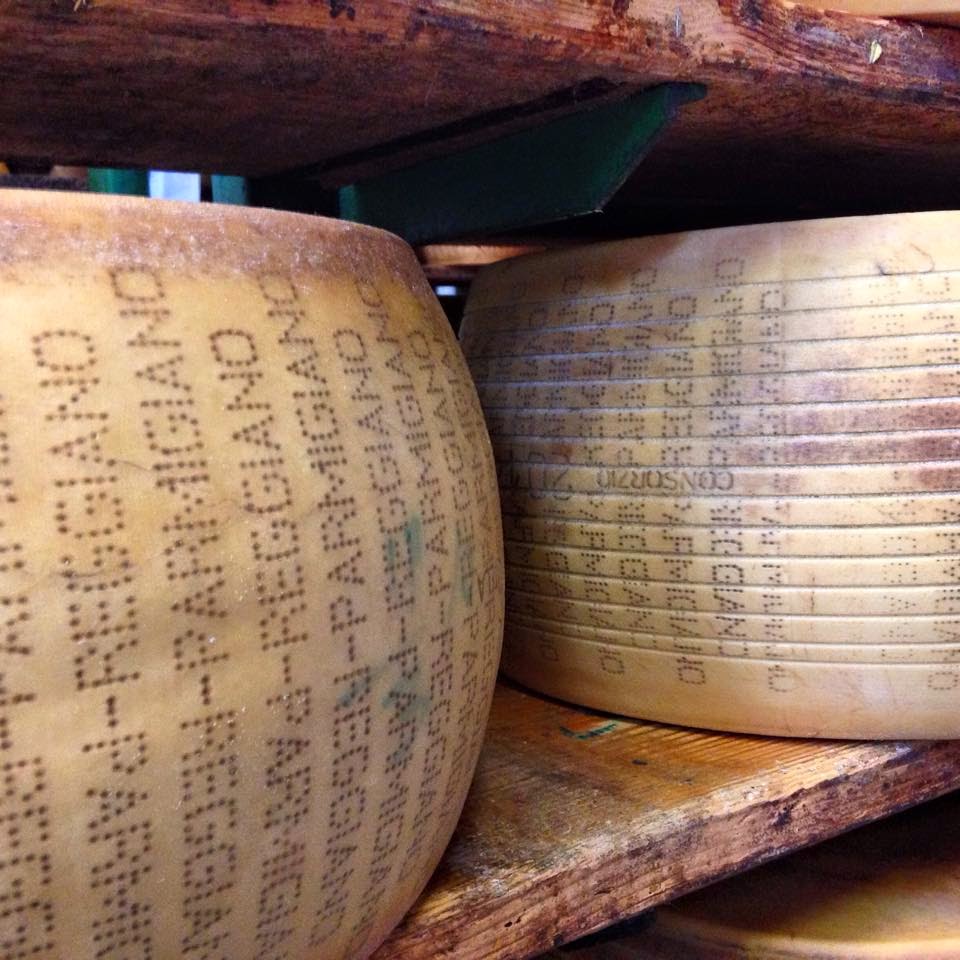
After the brining phase, the cheese wheels are brought to the warehouse for aging. Each wheel, about 35 kilograms, agest anywhere from 12-36 months. During the process, they are rotated and scraped down several times a day; there's a special forklift-looking machine specially made for going up and down the rows and flipping and scraping the cheese, to ensure they are aging evenly and staying clean. Our guide told us each wheel is worth roughly 500 Euro, and I did a quick rough count in the warehouse: 17,000 wheels of cheese, with lots of room for more! The rinds are stamped "Parmigiano-Reggiano" and dated, but they don't receive the official seal until they are just about ready for market. The cheesemakers use a very high tech tool - a hammer - to listen to the wheels. They are so practiced at this that they can determine whether a wheel has air pockets in it just by sound. Air pockets can mean the presence of bacteria, but it doesn't mean the cheese is bad. It does mean it can't be sold as official Parmigiano-Reggiano though, so those words on the label are scored through once. If after more aging there are still unexpected air pockets, the words are double-scored so that they are no longer readable. This cheese is just sold as "Italian Cheese" and though it is of a lesser quality, it is still delicious.

Left: Parmigiano-Reggiano Right: Cheese that didn't pass inspection and will be sold as lesser quality
Stacks of cheese in the warehouse next to a cheese-flipper machine
After finishing our tour of the warehouse, we went to the gift shop. I promptly purchased a cheese knife (traditionally, Parmigiano-Reggiano is cut with an almond-shaped blade), a ceramic cheese bowl, a new microplaner, and 1/2 kilo of 24-month and 1/2 kilo of 36-month cheese. When I got home that night, I made a big batch of ziti and topped it off with a mozzarella and Parmigiano-Reggiano mixture. Deeeeelicious.

I found the wikipedia page for Parmigiano Reggiano to be pretty informative, and surprisingly I retained a lot of the information our tour guide told us. I guess I pay pretty good attention when it concerns food. ;)

Sunday, May 3, 2015

Soave

I recently had the pleasure of visiting the Bonamini olive oil azienda just outside of Soave with some of my volunteer friends. And one of them had a visitor from the States to round out the group. I learned the official way of tasting olive oil, which is a little bit strange; saw a "baby" olive tree that was about 120 years old; toured the warehouse where olive oil is made; and saw some very old restored olive presses. If you ever get the chance to visit, I think you should! My friend Cara went the same week with a different crowd, and her blog post about it is a great summation: Cara's Bonamini Experience


After our olive oil-tasting (and buying) experience, we continued down the road to the city center of Soave for some wine-tasting! We were hoping to visit the Soave Cantina, which is known for its fantastic cellar, but they were booked. Instead, we went inside the city walls to Coffele, where they were ready and waiting for us. We walked through a gorgeous wisteria-covered courtyard to their tasting room. I have to say, I love the typical Italian wine-tasting experience; if you call ahead, 9 times out of 10 you will arrive to a beatifully set table with a spread of meat, cheese, and crackers. Coffele was no different. Our wine sherpa spoke six languages and had just returned from a conference in Germany, so she stumbled between the three languages a few times. It was pretty funny, but she did a great job telling us about their wines and the wine-making processes they use. Coffele produces 120,000 - 130,000 bottles per year, and exports to a dozen or so countries, including China, Japan, Denmark, and Canada. I left with a bottle of Amarone, and would like to go back to purchase some of their Bordeaux blend Nuj. Note for future reference: Coffele only accepts cash, so come prepared.
 
Inside the Coffele courtyard


Pronounced "New-wee"
 
Inside Coffele's cellar
Inside Coffele's tasting room
After wine-tasting, we went to a local trattoria for lunch, where I had...um, I forgot. But it was delicious, whatever it was. I usually order the duck bigoli, because I love to compare different versions of it, but I went with something different this time. Papardelle, I think. Oh well, I would go back! We were there on a market day, but didn't have time to wander around. Soave is a walled city and you can visit the castle and walk on the walls, so I'd like to go back sometime and make a day of it: taste wines, walk the walls, and eat good food.  

Friday, March 13, 2015

Brendola, part 2: L'incompiuta, town, and La Pergola Trattoria

After we left Volcar Spa, we headed toward the old part of Brendola. Before we quite got to the old town center, however, we made a very brief pit stop at L'imcompiuta, or the Incomplete Church. Construction of this building started during Mussolini's reign, during the 1920s and was halted for budgetary reasons. I think it is in a glorious state of decay and would have loved to poke around inside it, but unfortunately it is fenced off so you can only really appreciate it from the outside. However, the church is enormous and juts out more or less by itself halfway up a hillside, so if you are headed into the Berici Hills toward Brendola, you can't miss it. There's a place next door called Monkey's Cafe, which looked really cute; although I didn't get a chance to try it out during our class field trip, I would patronize it just for the fun name.

L'incompiuta: The Incomplete Church

Here you can see L'incompiuta from above
After poking around at the unfinished church for a few minutes, our caravan continued onward to the main (only) parking area in Brendola, which is a tiny town of only about six thousand residents. The first picture below is looking up toward the Madonna dei Prati church. Madonna dei Prati means Madonna of the Meadows, and I can only imagine it's called that because of the views. A quick wikipedia search reveals there's been a worship site on that particular hill for hundreds of years. Though the church building itself was reportedly built in the 1600s, its entry portals date to the 15th century and the building was built atop a probable pagan worship site. [Edited: After doing some reading about the Brendola area, I'm not convinced I got the name of this church correct. I'm going to leave it for now but I will update once I confirm the true name.]
Madonna dei Prati, as viwed from below

Madonna dei Prati Roman Catholic Church
View of the surrounding area from Brendola, in the Berici Hills; on a clear day you can see Romeo's castle
Originally our class instructor was going to take us to lunch at a restaurant called Novecento (nine hundred) which is situated right next to the church and is part of a B&B. Unfortunately, it was closed for renovation, but it's also on my list of places to visit on a future trip to the area. In this context, the name Novecento actually refers to the year 1900 (mille novecento) and the origins of the restaurant, which is probably still run by the same family.

Since Novecento was closed, we walked back down through the tiny town to the parking area, practicing giving directions in Italian. "Sempre dritto, giri sulla destra..." Luckily the town was so small there was no way we could get lost! Once again, we loaded up our caravan and headed a few kilometers beyond the town to La Pergola Trattoria, which is a locally famous place with absolutely stunning views. The parking area is adjacent to a vineyard, and I would love to go back later in the year when the vines have leaves on them. And as promised, we had a better view of the castle ruins from the restaurant. Rocca dei Vescovi, or Rock of Bishops. It's also sometimes called the Castello dei Vescovi, or Castle of Bishops, and dates back at least to the 1000s, though it was at least partially destroyed and rebuilt in the early 1500s. The ruins were originally designed as a watchtower because they are so high up. You are allowed to hike up there, and I bet the views from the very top of the hill are stunning! Have I mentioned yet that I would like to go back to this area and do some more exploring?

Looking out into the valley from La Pergola

Looking up at the Rocca dei Vescovi
We sat down at several long tables put together, and a waitress opened up bottles of red, white, and sparkling wine. Oh, Italy, how I adore you. And your lunches. And your alcohol. We got to try a 2013 and a 2014 Cabernet Sauvignon, which were both pretty good. The white wine was called a Gambellara, which was very very boring, and the sparkling was a Brut Spumante. All were local!

Our first course was a purple potato soup with little pancetta crisps and bread on top. It almost had the consistency of refried beans, but it was quite good. Next we had one of my favorites: risotto! This was zuca e trufoli, aka pumpkin and truffles, and it was really delicious, perhaps the best risotto I've had since I moved to Italy. The Berici Hills are known for their black truffles, which are plentiful and cheaper than the white variety. One of my classmates piped up that there's a local training course where you can drop your dog off for three weeks and when you pick it up, it's a trained truffle hunter! Doesn't that sound like fun? I would love to go truffle hunting one day. Dessert consisted of an apple tart thing which I don't know how to describe. Our instructor called it an apple pie, but it didn't resemble any apple pie I've ever seen. They came in little round pats as if they were made in ramekins, and had a texture somewhere between a pineapple upside down cake and a creme brulee. Regardless of what it was called, accompanied by fresh custard it was a perfect finish to the meal.

Inside La Pergola, which was decorated for Easter
Here's one last picture from earlier in the day, which might just be my favorite. The sun was shining, the air was clear, the company was nice, the food was delicious, and now I want to go back and share it with more people!