|
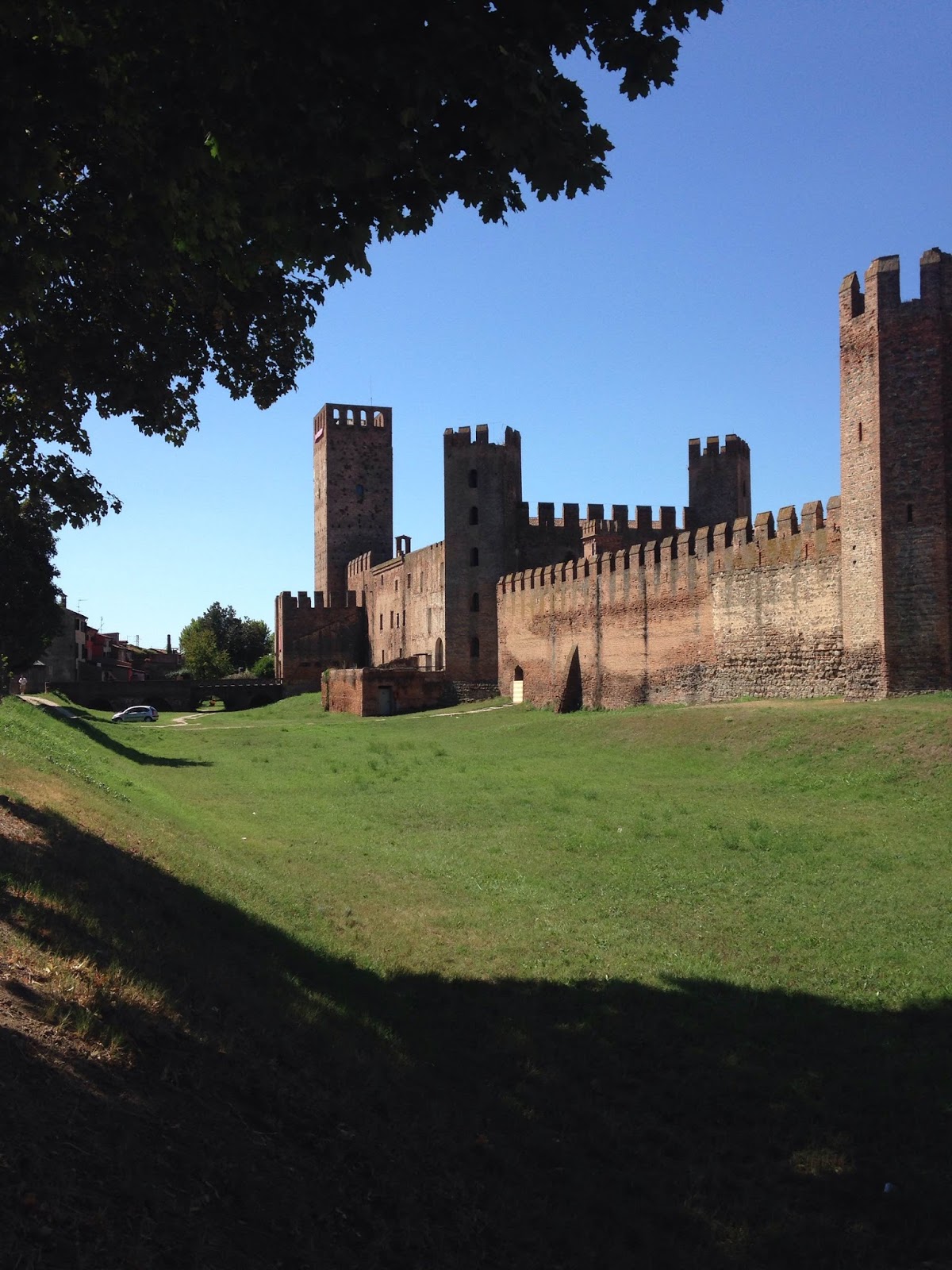
| Monselice Castello |
It took about 40-45 minutes to get to Monselice from Vicenza; it was an easy drive and tolls were less than five euro each way. You can see the hill with its tower before you can see the town proper, so we definitely knew we were heading the right direction long before we got there. Sometimes driving in Italy can be stressful, so affirmations like giant, easily-identifiable hills are a boon. We didn't exactly know where to go in town, so the vague plan was to arrive, look for the town center, and park somewhere close. That's generally a good plan, provided you don't accidentally stray into a residents only traffic zone, and it worked for us. When we arrived, we saw lots of people walking about in medieval costumes, so we knew we were close to the right spot. We started venturing away from that area of town and quickly found ourselves along a river in a residential neighborhood, so we stopped and asked for directions from a local. Twice. Thank goodness my aunt speaks better Italian than I do! We ended up just nabbing a great parking spot (for free!) along the river, and walking five or ten minutes into town, following the general flow of foot traffic.
 |
| Outside the Pub Enoteca Il Castello |
One of the first things we saw once we walked into the town was a piazza, and bordering the piazza was a tower, clock, castle, and tourist information office. Bingo! We popped into the tourist office to obtain directions to the horse race and determine if there was anything else interesting or worthwhile to see while we were in town. I have no idea why more people don't know of this city, because it is home to a fantastically refurbished castle dating back to the 11th century, a pilgrimage of seven churches, two towers, and at least one really great restaurant. (There are probably more delicious restaurants, but we liked this one so much we ate there for lunch and came back for dinner!) We scoped out the castle tour schedule and then hit up the Pub/Enoteca Il Castello for lunch. And why is it called Pub/Enoteca Il Castello, you might ask? Because it is located directly under the castle, has a secret passage connecting to the castle, and is owned by the city. A wonderful lady named Sabrina co-manages it with her husband. The inside is decorated with art, statues, pottery, and weaponry and the outside features a wonderful courtyard and seasonal flowers. Of course, since it was so nice we chose to sit a fuori, outside. We were intrigued by their extremely well-priced wine list, which is broken down by region and features some very local varietals, and asked about the possibility of a wine-tasting. The pub was slammed for lunch (always a good sign) so they suggested we come back in the early evening if we wanted to do that. Spoiler alert: we did. Two of us chose to have papardelle with wild boar ragu, and my aunt had crepes stuffed with ricotta and mushrooms. I drank a spritz and the others enjoyed some Prosecco, and then we were off to the races!
We walked for 10-15 minutes through the town to the foot of the hill, where we paid ten euro and sat in the bleachers with our backs to the sun to enjoy the spectacle. We had to pass through a gaggle of folks in costume to purchase our tickets, so we knew there would be a parade to kick everything off. Knowing Italy, we didn't think they would start on time, but they actually started five minutes early! Each of the nine communes of Monselice is represented by an animal or other symbol, and has its own colors. A representative troop from each commune marched in, accompanied by drums and/or buglers, and took their places in the opposite bleachers. They must have been broiling, what with all the velvet and brocade and facing directly into the sun! Unfortunately, the racing took for-eh-ver to start because various possibly important people needed to give welcome speeches. And then a cute kid read a presumably cute poem. I picked out a stanza about each commune, praising their speed, agility, horses, pretty colors, etc. People clapped. It was nice. More speeches. Blah blah blobbity blah, get to the good stuff! Finally, after no kidding an hour, the announcer started introducing the horses and riders and explaining the race.
 |
| A rider uses his joust to spear a suspended ring |
Each commune had two riders, for a total of 18. I know this because all eighteen of them were introduced one at a time and each completed a lap around the track. See note above re: for-eh-ver. They would be pitted against each other two at a time with the task of spearing three impossibly small orange rings while racing around the track. Each rider would enter his respective outer side of the track when a two-minute warning bell rang. When that bell sounded, the competitors had two minutes to collect their spears, enter the inner track ring, and take position. They got a 30-second warning and a 5-second warning. Once the five-second warning sounded, they could begin racing the horses, but they couldn't cross the starting line with the rings until the official start bell sounded. We only saw one false start, which I thought was pretty impressive. The riders did one full lap before starting to collect their rings on the end of their jousting spear, and the rider who got three rings before the other won the heat. I think we stayed for five races, and the times ranged from 52-56 seconds, so you can understand the dirt track was not all that large. After each race a team of men wearing blue jeans, white button-down shirts, and baseball caps came out to rake the track, especially in the curves where we saw more than one horse stumble, but once everything kicked off there was a race every 5-6 minutes. So if you ever want to attend this event, know that you can pretty much skip the first hour and not miss much, but once it starts things move fairly quickly. Still, with so many riders it could take a couple hours to finish all the racing. This event was not nearly as big as the Palio of Montagnana, but equally well-organized. I'm glad I got to experience the two different styles of racing, and would recommend them both to anyone. Both events were very kid-friendly, too.
Because of our desire to see more of the town (and the fact that bleachers just aren't very comfortable), we left after only a few races. We headed back to the tourist shop to steal some of their very pretty brochures and then went to the Castello of Monselice, sometimes called the Castello Cini after one of its modern owners. We paid eight euro for an hour-long tour, and lucked out because we, along with one very lovely Canadian lady, wound up on an English-speaking tour for us instead of stuck with a group of 30 Italian-speakers. So we basically got a private tour of one of the most beautifully renovated castles I've ever seen, and our guide was exceptionally knowledgeable. It turns out he is an Italian who works for an American company out of Verona, and only works in Monselice on the weekends after putting in a regular five-day workweek. Art is his passion, and he joked about there not being much money in art, allora. For every question we asked, he was able to give us a detailed answer, and I was really impressed with his kindness and professionalism even though we could see he was just about dead on his feet. (At the end of the tour, our Canadian friend told him to start a six-day work schedule and take some time off.)
The castle consists of three main buildings (plus the bonus pub on the street below), connected but built across the span of several centuries. Unfortunately, the castle was bombed, left in shambles, and abandoned for a significant period of time so much of the layout, room purposing, and furnishing is speculation. That did not deter from the experience whatsoever. The first building we entered was set up as a weapons museum, and we learned one of the first rooms was likely used as sort of an armory and mudroom for local soldiers, who apparently had a crappy life back in the teen-hundreds. Poor blokes. We learned a lot about crossbows and suits of armor before moving on. We breezed through a courtyard and then walked up some stairs and then a ramp to the [European] first floor. As it turns out, the ramp was so visitors could ride their horses directly to the guest quarters and living space, hand off their animals to servants to be stabled, and enter the house without bothering with the peons on the ground floor. We weren't allowed to take pictures of the interior, and I was a good girl and followed the rules, but let me just tell you this place was stunning. There were tapestries on the walls, giant windows, tiny beds, heavy cupboards and wardrobes, and beautiful examples of glass, pottery, and other art. We also learned about some special chimneys very specific to not just the region, but this town. I commented earlier in the tour that I thought it was unusual to see so many round chimneys, and only one that was squared-off. Turns out the round chimneys housed smaller regular chimneys underneath, with a void in between. In medieval times, residents filled that void with sand, to retain the heat from the fireplace even once the fire was out. Brilliant!
 |
| View from the upper courtyard in the Monselice Castello |
 |
| Upper Courtyard in the Monselice Castello |
 |
| One of the seven chapels |
After the tour, we continued walking uphill and peeked at the grounds of a private villa and into the Church of San Giustinia (St. Justina) which is also known as the Old Cathedral of Monselice. Continuing uphill, we walked past the Santuario Giubilare della Siete Chiese, or the Jubilee Shrine of the Seven Churches. There are seven chapels built into the hill, each one representing one of the major basilicas of Rome. They were constructed in the 1600s after a papal dispensation which basically said that a pilgrimage to these chapels was the same, and thus worthy of the same indulgences as a visit to the basilicas of Rome. Pretty good deal considering the status of travel in those days and the distance to Rome from the town. Each little church has a painting of its counterpart in Rome, and the seventh church also houses some pretty important and macabre relics. The seventh church is adjacent to another villa, across from which lead two sets of stairs. The first steps lead to an arched wall, and there were many people (mostly young folks) hanging out on the wall and steps enjoying the weather and the view of the town below. The second set of steps lead to the top of the Colle della Rocca, where there's another defensive tower. You can walk up there and climb the tower, but they let in the last visitors at 1800 and we got there around 1810. Boo. Oh well, we still enjoyed the walk and view.

After scoping out the santuario, we headed back down the hill. We were thinking of doing wine tasting and having munchies at the castle Pub/Enoteca again, but were all pretty hungry so decided to have dinner as well. The establishment was far quieter than on our first visit, and we snagged a primo table outside. We started off by tasting a Serprino and a frizzante rose; I enjoyed the rose more and the other ladies preferred the Serprino, and they both worked out nicely with our meat and cheese platters. We decided to skip the whites and go straight for dinner and reds. For dinner, I ordered gnocchi with duck ragu, my aunt ordered veal ossobucco, and my friend ordered boar goulash with polenta. I think we were all very happy with our choices (I definitely was!) but my friend said the goulash tasted exactly the same as the boar ragu from our papardelle lunch. Still delicious, but basically the same meal only with polenta instead of noodles. Allora. We tasted a Merlot, a Merlot blend, a Rosso Riserva, and a Valpolicella. We all preferred different wines, and my favorite (surprise surprise) was the Valpolicella. I also got some tiramisu for dessert, and it was probably the lightest and fluffiest I've had since I moved to Italy. I ogled some of the other plates and desserts as they came out of the kitchen, and they all looked fantastic. Maybe next time I will order the mushroom and pumpkin lasagna, because I got a waft of it and it smelled delicious.
Another great adventure for the record books. Next time, I will climb to the tower when it's open, properly look inside each of the chapels, and do some more exploring around the town. I'll probably eat at the same restaurant though. Why try a new place when I've got a winner with unexplored menu options, amiright?
***
Here are some more pictures from the interior of the castle, which I did not take since I'm not allowed. Here is the original source: Monselice Castello
 |
| Armory Museum in the Monselice Castello |

Interior room of the Monselice Castello
 |
| Interior Room and Chimney in the Monselice Castello |