Friday, April 8, 2016

Four-Leaf Clovers

I find more four-leaf clovers than the average person. I joke it's because I spend more time actively looking for them than the average person, but I do think I have a knack for it. I would say that maybe it's genetic, because my dad has also found more than his fair share, but my brother says he's never found one at all. If you ever want to give it a whirl, here are my very highly scientific (ha!) tips and tricks of the trade.


1. Look for them.

I'm not joking or being facetious. You'll never find one if you don't look. Go to a local park, find a big patch of clovers, and start looking. Convince your spouse to go on a picnic. Just devote an hour to it and tell your kids it's a treasure hunt. Look along the curb when you're walking to your local coffee or gelato shop or to the mailbox. Even if you don't find one, you'll still have passed a good afternoon outside. Just, you know, be mindful of sunburn and bugs and cow poop. Or sheep poop, if you live near Vicenza...

2. Don't waste time looking through the wrong sort of clovers.

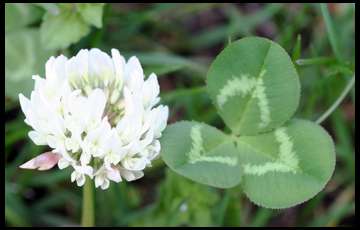
White Clover
If the clovers have triangular or heart-shaped leaves, you probably won't find a four-leaf clover. Most four-leaf clovers come from your every day garden variety White Clover. Also, quadrifolia plants masquerade as clovers, but they're not. Sorry to burst your bubble!

3. Start at the fringe of the patch.

For some reason, most of the four-leaf clovers I find are toward the edges of the patch rather than the center. I think maybe the runners are more exposed to things that could cause damage. Or maybe just the runners are more likely to be genetically corrupt. Who knows. I like to look around the edges of a patch, maybe moving in a circle, and tend to skip looking in the middle.

4. Don't look too hard.

That might sound counter-intuitive, but I find I have better luck when I scan rather than search. It's easier for me to notice a disruption in the pattern when my eyes are less focused and moving quickly. Sometimes I'll stand over a patch and lean over it a bit, and just poke around with my foot if something catches my eye. I don't look at the leaves too much; I tend to look for the white rings at the center of the clover. If I'm sitting down, I might run my fingertips through the patch to sort of separate the clovers from each other, but usually it's not necessary unless something catches my eye.
I count four...
5. If you find one, don't stop looking!

I remember walking through a disc golf park with my brother and mentioning that I find them often. No kidding, within two minutes I glanced down and one just jumped out at me. He said something like, "No way" and then within a few steps I found another one. This is how it goes though: where there's one, there's likely another one nearby. Last weekend I looked at dozens of patches and didn't see a single four-leaf clover. I was about to give up when I saw one more patch at the base of a tree, and stopped for a peek. Within 10 minutes I found 14 clovers! One of them had five leaves and one of them even had six leaves! I don't normally look around trees, but I definitely will in the future.


6. If you find one and choose to pick it, press it right away.

Clovers will shrivel up quickly after being picked. I've tried plopping them in vases of water and I've even tried plucking some with bits of roots to see if I could get them to grow at home, with no luck. (Yet.) I like to put them in the pages of a book (my Italian cookbook, to be exact) but a lot of people swear by wax paper. You know what else is a good option? A good old-fashioned phone book. If you use a book to press your clovers, use a nice heavy book with thin or textured paper, not the glossy kind. Trying to press a clover in glossy paper might result in mold or mildew. Yuck. That's why I personally avoid wax paper. Just beware that the clovers become brittle after time, and a sort of dull gray. Some people recommend pressing twice - once fresh, and once after a quick brush with green food coloring. I've never tried using food coloring on a clover, but since I've got such a collection going now, maybe I'll give it a whirl and see what happens. You can laminate them for bookmarks, use in coasters or paperweights, or even make jewelry out of them. I personally believe your luck is even better if you share your finds with a friend. 

Happy hunting, folks. The sky is the limit!

Wednesday, April 6, 2016

Kaiserslautern, Germany: KTown for the Win!

I recently had the opportunity to travel to Kaiserslautern, Germany for two weeks of work-related training. I've been to Germany once or twice before, but until this trip never had any real time to spend in the country. I stayed fairly busy from 0800-1600, but after that I had free time whenever there weren't work dinners to attend. And for the record, I am not normally a fan of "mandatory morale" functions, but I have such a fantastic group of co-workers who also happen to have excellent taste in food, so these outings were never a burden!

The flowers in Germany knew it was springtime, but someone forgot to notify the sun. I think if I'd stayed another week, I would have seen many more buds and blooms on the trees, but it was still a little gray and dreary when I was there. One of my favorite weather adjectives is "Seattle-ish" and if you've ever lived there, you know exactly what I mean. It only really rained once or twice in two weeks, but that's about how many days of sunshine we had, too. Mostly it was just a bit overcast, cool but not cold enough to be uncomfortable. 

When I arrived, there was some sort of street fair going on right outside my hotel. I stayed at the SAKS, which straddles the line between new and old Kaiserslautern. It's a great location for walking and exploring, and happens to be situated right on a plaza. After I unpacked my bag, I wandered outside for some exploring. At first I didn't see anything out of the ordinary - roasted nuts, carousel, lavender soaps. And then I saw my first pretzel! Have I mentioned that I am a fan of pretzels? I can be a bit leery though, as I had both the best and the worst pretzel of my life on the same day in Munich, about two blocks away from each other, which just emphasizes that one just never knows. I did a little pretzel research (by this I mean that I both ate a lot of pretzels in the name of "research" but also did some Googling and lots of reading, not that I went to a library or searched specifically for scholarly articles on pretzels, because, duh, that would be overkill) and discovered there's quite a deal of history to this seemingly simple concoction. Some stories say pretzels were invented in the 600s by monks in the area where Italy and France currently meet, while others of course give credit to the Germans. There is a distinctly Venetian version of pretzels called precedella, which are traditional pretzel-shaped but sweeter, flavored by such additives as wine, anise, or cinnamon. Then there are American-style hard pretzels, credited to the Pennsylvania Dutch, who aren't really Dutch at all but German, and those pretzels are distinctly different from their European counterparts. There's also debate over dipping the pretzels in a very caustic lye bath or a more moderate baking soda solution, or just foregoing that part for a water mist or quick boil, a la bagel. And then there are all the delicious things you can top a bagel with! Salt flakes, of course, being the most traditional, but then you have cheese (my favorite, especially when it gets all crispy) or cinnamon-sugar or chocolate.
German Pretzels
I'm digressing. I noticed it when I started drooling. Sorry about that. Anyway, the street fair was fun, the pretzels were delicious, and I especially enjoyed listening to all the music. There were two different marching bands, plus an accordion player and a pan flutist. I passed several booths of vendors selling cheeses and of course sausage, but my euro stayed safely in my wallet. 

Work was good, though it made my brain tired, and my co-workers are lovely. That's about all I'm going to say about that. Mostly I carpooled to work, but sometimes I caught the hotel shuttle and once or twice I even walked. While there was a little break room on site, our food options were pretty limited nearby, but we made do. We ate out a few times, walked to a local bakery a few more times, ordered food to be delivered (once, with sad results), ordered food to be picked up, and survived. The Asian buffet was okay, the Indian food from the Curry House was delightful, I thoroughly enjoyed the wraps from the bakery, and we should probably never speak of the delivery food ever again. Okay fine. I had falafel and some sort of red sauce eggplant ratatouille, which I really enjoyed once I added some salt. But my poor coworker ordered fish and potatoes, and the potatoes tasted fishy and the fish tasted bland; all of the food was white and boring and entirely off-putting. I later learned that Germans are not known for their fish-cooking prowess, but I'm not entirely surprised to learn this. As much as I love Italy and Italian food, I thus far have not been impressed by their fish dishes, either, but I haven't given up yet. For the most part, Italians seem to stick to Italian food. There are a few international cuisine options, but they are few and far between where I live, so whenever I travel I always look to try new food, whether it be local or from far-flung corners of the world.

In Germany, a few people particularly recommended I try a dish called Flammkuchen. It's basically a flatbread, traditionally with creme fraiche, onions, and bacon. Sign me up, please! I couldn't believe how light it was, when I was expecting something heavy. I can't wait to try making this at home sometime. (The picture is from a food website and will take you to a recipe.) My other favorite German food is now kase spaetzle. I had it twice, and tasted somebody else's once. (Really, that time I wanted to devour my co-worker's food but decided to be the bigger person and politely try a bite instead of stealing her plate and running away to a corner to shove my face into the food.) It's better than macaroni and cheese, when done right. And I don't feel even remotely guilty or un-American for saying that, either. It's egg noodles with cheese and magic and caramelized onions and possibly breadcrumbs and gravy and unicorn love. It's another dish I can't wait to try making at home but also feel will in no way do justice to the meals I consumed in Southern Germany.
Flammkuchen! 
By far my favorite meal was from my last night in Germany, when my boss introduced us to a Greek restaurant called Sorbas (or maybe Zorbas?) about 20 minutes outside of Kaiserslautern. We were a group of seven people, and we left the ordering to the two Greeks. They ordered an assortment of food for us, sort of tapas-style, and we dug in. I haven't been so very full in a long time. There was tender octopus, crispy fried eggplant, garlicky tzatziki, chicken, lamb, bistecca patties, salad, and of course warm, homemade pitas. I think there were a few more things but honestly I can't remember. Suffice to say, it was really good.
(I stole this collage from Angie's Instagram page because I was too busy stuffing my face to take photos.)
Trier, Germany
In the non-food-related topic of things I did in Germany, the highlight was definitely my trip to Trier. The town, nestled along the Moselle River near the Luxembourg border, came highly recommended by so many people that I braved public transport in a foreign country in order to visit it. Woohoo, look at me adventuring forth! It took about 2.5 hours via train to get there and my co-worker/friend and I arrived sometime before lunch. We trekked off by foot to the Porta Nigra, the oldest Roman gate North of the Alps, and then took a left-hand turn into the historic center of the city. We wandered along the cobbled streets for a bit, and found the ruins of the Roman baths, too. We visited the Constantine Basilica and the Trier Cathedral, as well as the Trier Diocese Museum, which we had all to ourselves! It was light and airy and fully of beautiful art and artifacts. For lunch we stopped at a potato restaurant. Yes, you heard me: a potato restaurant. I had potato dumplings stuffed with meatballs, and they were lovely. I had a wave of dizziness at the restaurant, I think because it was really warm in there, but I did enjoy the food. After some more wandering and hot tea (it was cold!), we went to the Trier city museum. I loved it! I was very impressed with both of the museums we went to. I think my favorite exhibit was a floor full of old clothing. People were tiny a few hundred years ago, and the clothing looked so heavy! I bought a couple little gifts but we were pretty much done after the second museum. We headed back to the train station a little early, and waited a while. Funny story: we got on the correct train, but my friend heard announcement that half of the train was going one direction (to Luxembourg) and the other half was headed the opposite direction. And guess who was on the wrong half of the train! I'm so fortunate I was with someone who understood some German, because that announcement was NOT made in English. Whoops. Anyway we got off the train and sprinted forward a few cars and thankfully made it. The trip back was more or less uneventful (the lady in front of us had a horrendous nosebleed, but was ultimately fine) and I did nothing else interesting or productive with the rest of my weekend.
Porta Nigra Roman ruins viewed from the Trier City Museum courtyard
All in all, it was a good balance of work and play (i.e. food), and I'm happy to go back in the fall for more training. I would love to make a side trip to Heidelberg when I go back. That's my one regret from this trip, but hey, I still had a great time!

Wednesday, March 9, 2016

Wine-Tasting in Valpolicella Region

I recently went wine-tasting with a couple of girlfriends from work. (I work! I have girlfriends from work! Whoa.) We made plans to carpool to the Valpolicella wine region, just north of Verona. It takes about an hour to get out there from where we live, but the drive went by very quickly despite horrendous rain. We arrived for our 10:00 am appointment at Antolini in the town of Marano just on time, and were met by a very cheerful Paolo. 

First, we went upstairs into the grape-drying area. When grapes are dried for wines like Amarone and Recioto, it is important to have a cool temperature and just the right humidity. Many wine-growers use lofts of barns or warehouses, and control the temperature and humidity with a mix of old-fashioned ways and modern technology. Unfortunately, we just missed the Amarone pressing by a couple of weeks so we didn't get to see (or smell) the drying grapes or witness the pressing. Allora. Next we went to the cellar, where juice was fermenting in a variety of barrels. Antolini uses a mix of sizes and materials - 225L, 500L, 1500L, etc. I was most surprised to find they use not only oak barrels, but also chestnut, cherry, and mulberry. The wood is sourced from Italy, Slovenia, and America. Next we went back to the tasting room - but only after Paolo pointed out some of the vines next to the driveway. With thick, gnarly trunks, the vines were 40-45 years old and trained with a horizontal spread much like a scarecrow on crossed sticks. I learned that often the oldest vines produce the favored grapes for Amarone and Ripasso.

The tasting line-up at Antolini
Next up: the tasting! We got to taste all of Antolini's wines with the exception of the 2013 Ripasso. So sad; I love Ripasso! Allora. The first wine we tasted was, of course, the Valpolicella Classico. It was very fruity, but a little young for me. Classico is not generally my favorite because they tend to be pretty bright and sometimes too acidic for my test. Next up, a pleasant surprise, the Corvina. This is only the second place I've ever seen Corvina bottled on its own and not part of a blend (Monte Tondo in Soave being the first), and it was really delicious and slightly peppery (one of my favorite things to taste in a red wine). This was the first vintage they tried it at Antolini, from 2013, and I think it was a very successful experiment. It was more medium-bodied and fruity, but not nearly as tart as the Classico, and a hint of the oak and maybe some almond smells came through. Next up was the TheoBroma Rosso Veronese, which is a blend of Cab Sav and Croatina. I'm pretty sure the Croatina grape is one that is only used in Italy. The TheoBroma was the most tannic and oaky of all the Antolini wines, and is not something I think I'd gravitate to but I bet my husband would really enjoy. Finally, the moment I was particularly looking forward to, a side-by-side comparison of their two Amarone wines: Moropio and Ca Coato. Both great! The Moropio is more intensely fruity and has an underlying minerality, whereas the Ca Coato was very soft and velvety. I think the Moropio was a little more dry and spicy and the Ca Coato was more fruity, with a pretty good undertone of vanilla and subtle caramel. I'd drink the Moropio with food and the Ca Coato on its own. MWAH! Delizioso. Last, we tasted the Recioto, a very typical dessert wine from this region. And by typical, I mean they have literally been producing this wine in this region for thousands of years, long before Amarone and Ripasso were produced. My main issue with dessert wines is that often they are syrupy and cloyingly sweet. The Recioto from Antolini? Not at all! It's pretty amazing to me the difference it makes when you stop the fermentation process early to produce a Recioto versus letting it go all the way to make an Amarone. Same grapes, same process to a certain point, but wildly different results. This particular Recioto I think could be dangerous, because you can barely taste the alcohol. It's light and refreshing and I'm pretty sure I could just drink it all day if I was in the mood. 

After tasting all the Antolini wines - and putting a nice dent in my pocketbook when I purchased lots of wine to bring home - we asked Paolo if he had any lunch recommendations for us. He said his favorite restaurant was still closed for the winter, and told us about his second-favorite place. He even called and made a reservation for us, and gave us business cards for both places, for whenever we go back to that part of the country. Talk about excellent customer service! Oh, and Antolini is the only winery we visited that did not charge us a tasting fee.

Since we still had a good bit of time before lunch, we decided to make an impromptu trip to Fratelli Vogadori. We called ahead to make sure they were open and let them know we were coming, but it turns out that was probably unnecessary as they only had a few other people in the giant tasting room. We found it pretty easily, though I did have to make a crazy-tight turn into their driveway (fine, I admit, I Austin Powersed my way in there). They have a nice big gravel lot with a great view of the valley below, and the tasting room maximizes that view with lots of glass windows. We sat down right in a corner and one of the three brothers came over to walk us through the tasting session, and set out a plate of bread and their house olive oil -from the trees we could see right underneath us through the windows! First, the Valpolicella Classico, which - no surprises here - was too tart for me. Next up, their Valpolicella Classico Superiore Ripasso, aka the Ripasso, which was dynamite. One of my top wines of the day. It smelled like raisins to me but had a hint of cinnamon and maybe some other baking-related smell I couldn't quite identify. We also got to taste both of their Amarone wines, so I got a bonus side-by-side tasting. The first was delicious - very strong vanilla and caramel smells. The second was also delicious, and one of the most distinct chocolate-smelling and tasting wines I've ever had. It was also not as tannic as the first one. One neat thing about the second Amarone, the Forlago, was that every few minutes the smell and taste really evolved. Old-timers say that you should open a bottle at least one hour ahead of time for every year of its age. Many people will open a bottle in the morning to enjoy after dinner, or even open it the night before. Amarone can also age very well in the bottle, so of course it will probably taste very different years down the line. We also inquired about a couple of other wines on the list, and Gaetano (I really hope that's the name of the correct brother) kindly opened a bottle of Raffaello for us. The Raffaello is named for their father, and has been in production for about a decade. I think it's basically an Amarone, but they classify it as a Rosso Veronese IGT, so I'm not sure. It's aged in cherry rather than oak, so maybe that's why. Very yummy wine! Were we done yet? No. There's more! I was so sad to pour out so much wine throughout the day, but as the driver I wanted to be very careful and safe. We also tasted their Recioto, which was slightly thicker than the one from Antolini, and a little sweeter. Still, not at all too heavy. But wait, there's more! Oh yes, there is. The dreaded Grappa. Now, those of you who know me know that I am generally not a fan of Grappa. I like the ones that are sweet and taste like a liquid Jolly Rancher, but traditional Grappa is gross, and the herbed ones I find flat-out disgusting. That said, I actually didn't mind their Amarone Grappa aged in barrique. I don't think I would seek it out, but if someone poured me a glass I wouldn't mind sitting and sipping it to be social, and I might actually enjoy it. 
The tasting line-up at Fratelli Vogadori
I read a bunch of reviews on Trip Advisor, and I was surprised by some of the negative critiques. We had a great experience, and a very relaxed chat with one of the owners. He was very knowledgeable and we talked in a fair amount of depth about the history of the region, methods of wine production, and distinct characteristics of each wine. He did have to get up a few times to attend to other things - after all, it's his business! - but that didn't detract from the experience whatsoever. He was clearly passionate about wine-making and proud to share that their winery is so environmentally friendly - no chemical fertilizers, no pesticide, etc. I can see how possibly the place could get very full during tourist season and people's experiences might not be so intimate, but I have zero complaints or reservations. Speaking of reservations, Fratelli Vogadori also has rooms for rent! Each room has its own bathroom and there's a shared kitchen. I'm seeing an overnight trip in my future! 

By this time, we were more than ready for lunch. We trekked on over to Osteria alla Pieve, in the town of San Pietro in Cariano. Paolo knows the owner and chef, and they knew exactly who we were when we walked in, and walked us straight to our little table in a corner - across from the wood-fire merrily crackling in a fireplace. We each ordered a little appetizer, some acqua naturale, and another bottle of wine. (I tasted the wine, a DOC Valpolicella from La Giaretta, but I didn't really drink any. It was pretty good with food.) We each got to taste the Monte Veronese fonduta (local cheese fondue), prosciutto praga (Prague ham) with pickled onions, and polenta with mushrooms and cheese, if my memory is correct. I ordered pasta with black truffles, and my friends ordered Amarone-marinated steak, with potatoes and salads. And we got to watch the steaks cook on the fire! Color me impressed, and color the steaks the perfect shade of pink. Yum yum. The restaurant also has a huge wine selection, including wines made by the owners. I wish we'd had more time to sit and savor (and let's be honest, try dessert), but we had to head across the valley to our last wine-tasting appointment at Le Bignele.
Four typical grape varietals of the Valpolicella Region
And by across the valley, I mean over the river and through the woods and along some twisty, curvy, narrow roads. I think my knuckles are still white from the experience. I've been to Le Bignele before and definitely remembered some narrow and winding roads, but this time we approached from the opposite direction. We turned on a gravel road and headed up a steep incline, and near the top we passed a couple of farmers loading a tractor. About fifteen yards past them, the road did an exceptionally sharp turn to the left and appeared to dead-end in their "driveway." I backed into a flat area (presumably used for loading and unloading tractors) and pointed back down the hill. My friend rolled down her window and proceeded to tell them we were lost and ask if they knew how to get to Le Bignele. They pointed and said we were only three hundred meters away, back up the hill behind us. Apparently the road did TWO s-turns and it was so steep and sharp that we couldn't see the second one. We thanked them and I backed into the same turnaround spot (thank goodness it was there, or I would have been completely screwed) and carried on. I had to do another Austin Powers back-and-forth turn to make the second bend, and then it got REALLY interesting. Imagine a nice dirt walking path. Now imagine that path with some intermittent patches gravel. And now imagine that walking path has stone walls on both sides. And now use your imagination to picture a charcoal gray 2013 Honda Accord squeezing down that path so tightly that the mirrors only had a couple inches of clearance. Then about a hundred yards down the lane, add in two concrete strips where the tires should go. Now picture me driving that Accord, scootched way forward in my seat and sitting high over the steering wheel, slowly creeping along that road and praying there aren't any sharp turns. That was how we approached the winery. I can feel my heart rate speeding up just writing about it! 

When we finally, mercifully, arrived at Le Bignele, Sylvia (the owners' daughter) was ready for us. We got out of the car and she greeted us. Then she said, "And who is the driver?" I raised my hand and she said, "I commend you. You just took the ancient road. It has been there a very, very long time. When you leave, be sure to go the other way." (Spoiler alert: I did. It was still narrow and windy, but not nearly so nerve-wracking.)

Inside the Bignele Cellar, photo from their website
After a brief tour of the steel tanks, cellar filled with barrels, and grape-drying area, we headed downstairs to the tasting area. We all promptly fell in love with a shelf full of "Olivia Pope Wine Glasses," and then sat around the table. (You can purchase the glasses here: Crate and Barrel Camille ) Before Sylvia poured our first glass, we were joined by a local Italian gentleman who came in to buy some Ripasso but stayed to taste the whole selection when he heard Sylvia was doing a session for us. It was a merry group. We tasted five wines at Le Bignele: a Rosso Veronese, a Classico Superiore, Ripasso, Amarone, and a Recioto. I enjoyed the first very much, and again was not a huge fan of the Classico. I can definitely identify a trend! The Ripasso was dry and fruity, and their Amarone remains one of my favorites. It's a little more delicate than some, but still has great cherry and vanilla flavors. Very well-balanced and drinkable. I think perhaps it's less of an occasion wine than some Amarone out there. The Recioto was the heaviest and sweetest of all the ones we tried that day, but not in a bad way. Syliva served it with chocolate chip biscotti and joked that if we wanted to live, we'd only eat store-bought cookies at her place and not anything she cooked. At that point we told her about asking her neighbors for directions, and she instantly knew who they were, and said the lady is a very good cook. We said we should all go to her house next and ask for more biscotti! Le Bignele normally charges a ten euro per person tasting fee, but it is waived when you purchase their wine. After we made our last purchases, we loaded up the car and hit the road. I definitely remembered to go the more traditional route instead of taking the ancient road home, and was much more relaxed for having made that decision.

Overall opinion: If you want to go tasting in Valpolicella country, you can't go wrong at any of these three places. All three experiences were personalized to us. I think Antolini was the easiest to find and Vogadori had the best view, but I felt most comfortable relaxing at Le Bignele, if any of those opinions factor into your decision. All of the wines seemed pretty characteristic - lots of fresh cherry and red fruits, vanilla, caramel, cinnamon, and chocolate. I think there's probably something to suit everyone's tastes.

Bonus: Here's a great, simple run-down of the different tires of Valpolicella wines: http://winefolly.com/review/valpolicella-wine-pyramid/

Thursday, March 3, 2016

Recap: Scotland, Day 3

My last full day in Scotland can pretty much be summed up thusly: I had no plan and walked all over creation. I had a couple of things I wanted to do, and even though they didn't quite work out it was still a lovely day.

True to form, I got up early and, feeling spry, started walking. It was a bit brisk, but still sunny and pleasant. When I got to the Royal Mile, I took a right and headed downhill toward Holyrood Palace. I passed a bunch of coffee shops, all closed. On the way, I passed a beautiful church and a couple of museums that were, unfortunately, closed on Sundays. I also passed by the "new" parliament building and frankly, I think it's hideous. My brother is in school to become an architect (he graduates with a double master's in May!) and I'm curious to get his opinion, but I thought the building was too busy and didn't fit in with any of its surroundings whatsoever. It stood out in a bad way. (Update: while searching for images of the building, I found views from a lot more angles, including aerial, and now I don't hate it quite as much. I simply think it's unusual and still doesn't fit in with its surroundings.) I also passed a cute little tea shop and made a mental note to come back later, when it opened up.

Scottish Parliament Building, photo from http://www.edinburgharchitecture.co.uk
I spent a few minutes poking around the Palace and its gift shop, but decided I didn't feel like paying to go in. Instead, I continued walking toward Arthur's Seat in Holyrood Park. There were a few people already coming down the hill, and a few other souls like me starting to venture up. I didn't really plan on hiking to the top, so even though for once in my life I had appropriate footwear, I didn't have any water or snacks. Not knowing how long it would take me to reach any of the peaks, I just decided to start walking up until I got a) bored (not likely) b) injured (fairly likely, because rocks and gravity, yo) or c) thirsty (extremely likely, because no breakfast or snacks). Almost right away, I skidded on a patch of frozen water, commonly referred to as "ice" but fortunately I didn't fall and I didn't torque my back or twist a knee or ankle, so I kept on going. This is where I also witnessed one of the cuter moments of the vacation: a little girl, about 2- or 3-years old, was walking with her dad. She was wearing a little skirt and leggings and pink and purple flowery boots. She stopped to stomp in one of the frozen puddles and said, in her wee little Scottish brogue, "Daddae, Elsa has been here!" Adorbs.

St. Anthony's Chapel Ruins, photo from undiscoveredscotland.co.uk 
Even though Arthur's Seat s part of a long-defunct volcano, the walk was actually pretty easy, and I was impressed at the number of people out and about. I guess since I got lucky with another sunny day, everybody had the same idea to get out and enjoy it. Plus, "hillwalking" is a very popular activity in Scotland and Arthur's Seat is very accessible and popular. I walked to St. Anthony's Chapel Ruins, which overlook St. Margaret's Loch and a vast open space which, when I was looking at it, was being used for a very agile herding dog to play fetch with a frisbee. The chapel ruins are, well, ruins. There were two walls at a 90-degree angle and some arches for doors and windows. I continued up the path a little ways, and then decided to turn around and find food and rehydrate myself.

Not Madam Puddifoot's
My next stop was a little tea shop that reminded me of Madam Puddifoot's from the Harry Potter books. It was tiny and charming, with a flower and lace aesthetic going on. I asked for a pot of Scottish breakfast tea, a plain scone, and a "bacon-filled roll." The tea and scone were delicious, but the bacon roll was just a boring hamburger-type bun with bacon on it. It was very dry and boring. I sat in the warmth and read my Kindle while I savored the tea, and then trekked back uphill. I next ventured to the Writer's Museum, which I had really been looking forward to visiting. It was one of the places we passed during the free walking tour, and I thought I remembered the sign saying it was open on Sundays. Unfortunately, I didn't read the fine print that said it was open on Sundays during festival season (aka August), so I was very disappointed to find it was closed. Instead, I popped into a few shops and perused some cute clothes, beautiful woolen accessories, whisky, and chocolates. I also followed my nose to the St. Giles Cathedral Cafe, and made notes of its hours, since the curry smelled delicious. I went into the Cathedral and bought a photography permit for 2GBP. I think that's a genius way for churches and other historical sites to get donations without charging an entry fee. After poking around in the church for a while, I went back to the cafe and had some of the curry, which was just as delicious as it smelled.

Mmm, scone and tea
Happy Valentine's Day to Me!
I continued up the Royal Mile and stopped to listen first to a bagpiper and then to a violin player. Both were very talented and I made sure to chuck some money into their instrument cases. Next, I went to the Scotch Whisky Experience near the very top of the Royal Mile, and paid for a Gold Tour. That included the basic tour experience and tasting, plus four additional tastes of single malt whiskies from each region. The little tour was pretty hokey, but still fun and informative. We did get to view the world's largest whisky collection, which was beautiful. I also thought the group tasting part of the tour was pretty phenomenal, and not just because it included scratch-and-sniff cards! Our guide gave us some interesting history about the four whisky-producing regions of Scottland, and told us some of the traditional scents and flavors one can expect from whiskies typical of each region. I was most intrigued by the scents and descriptions from the Lowlands and Highlands, and knew immediately from smelling the Islay card that I would hate (or at least strongly dislike) a typical whisky from that region. During the group tasting, I elected to taste a blended whisky that sounded good, simply because I knew I'd get to sample single malts later. I discovered I liked it better with a few drops of water added, which was unexpected. After the group tasting, we moved into the tasting room, which had a fantastic view. I plopped down at the bar for my four VERY GENEROUS tastes. Surprisingly, my favorite smell (Highlands) led to a disappointing whisky, and the whisky from Speyside was pretty darn delicious. I think I could turn into a whisky drinker after all. And my tasting notes from the Islay whisky? "A leathery, salty, smoked fish, and not in a good way. Blech." If a whisky description includes the words "peat" or "smoke," I guarantee I will not like it. So there you have it. This tour was definitely worth the money, and to boot I am now a member of their whisky appreciation members' club! I think mostly that means I am entitled to some discounts for the next year, including a 2-for-1 tasting at a later date. I told Tony, "Forget Rome. Let's go to Edinburgh!" I really only tasted each drink, and felt a little guilty about leaving so much scotch on the table, but I also didn't want to finish my last day buzzed. I think a proper whisky tasting deserves a lot more time than I was willing to spend, and the drinks should really be savored, so I'm confident I made the right call.

You had me at "scratch and sniff"
Exterior of the Royal Castle
Next, I went another couple hundred yards to the very top of the Royal Mile and decided to spring for entry to the Edinburgh Castle. It was 16.50GBP to enter, and I had just exactly 2 hours until closing - exactly the recommended length of time. In hindsight, I wish I had 3-4 hours, because two hours wasn't enough time, and some of the museums started closing their doors well before closing to manage flow. Before I went, I didn't realize the castle was really a compound. There were many buildings and museums, and it's also home to the Scottish National War Museum. Honestly, I could probably write an entire blog post just about my two hours inside the castle. The highlights for me were climbing the walls and taking in the view, and also the Crown Room - which contains The Honours of Scotland, aka the crown jewels. There were also some really fascinating exhibits on prisoners-of-war, including some old doors with grafiti and etchings from as far back as the 1700s. From start to finish, I thought the castle experience was pretty fantastic and incredibly well-thought out, though I was annoyed that I didn't get a chance to go into the regimental dragoon museum because of the aforementioned closing time. Other than that, I give this one a big thumbs up. There were several cafes and tea shops, plus of course the requisite gift shop, but since I was still full of scotch and curry I didn't bother to stop so I don't have any particular feedback.

The Honours of Scotland
View from the Mills Mount Battery
  (All three of the pictures from the Edinburgh Castle were taken from its official website gallery: Castle Gallery)

St. Giles Cathedral, aka the High Kirk of St. Giles
Pretty much my last stop of the day was St. Giles Cathedral. "But Elaine," you might say, "didn't you already go there once? Why go back?" To which I would excitedly reply, "Because there's a free choral concert!" After the sun went down, the church was FREEZING, so I was happy to have my scarf and coat. I was early enough that I didn't get stuck directly behind a column, but late enough that I still had to sit at a funny angle to see anything, and about half of the group wasn't visible to me because there was still a column in the way. The church was pretty packed, and I could tell that most people were locals rather than tourists. I was really surprised when about 80 people trooped out and took their positions. The director said we'd be going on an around-the-world tour, and they kicked it off with three songs. Meh. One soprano kept going WAY sharp and it hurt my ears, and I wasn't so impressed overall, to be honest. I think the acoustics were probably a bit challenging, too. But then most of those folks took their seats and left a group of 12-20 people behind to sing a few more songs (I'm not sure how many because, again, COLUMN) and they really blew me away. They had great energy and the dynamic was just really fantastic. The rest of the chorale came back to finish up with a few more songs, and one of my favorites was an Ave Maria I'd never heard before. I think maybe they just needed to warm up a bit, because I thought their performance was much more unified for the second half of the evening. We heard songs from Scotland and Ireland, the U.S., New Zealand, France, and I think Ecuador, all in different styles. The entire concert lasted a little over an hour and I'm so glad I went. I think the cathedral does a weekly concert on Sunday evenings, but I can't swear to that. Anyway, if you're ever there on a Sunday, I recommend you at least swing by to check out their calendar. The regular church choir sings at two services on Sundays, and I'd venture to guess they're worth a listen, too.

Inside St. Giles Cathedral
(Both photos of St. Giles Cathedral came from sacred-destinations.coml.)

After the concert I more or less headed back to my hotel to pack and sleep. I only made one pit stop at a local market to grab some fresh fruit for dinner and breakfast. I'd intended to have dinner out, but I was still pretty full from the curry. I got up Monday morning and caught the bus to Waverly Station, and then transferred to the airport shuttle. It was a really easy process and everything went smoothly at the airport, too. Edinburgh gets an A+ from me in terms of access and attractions, and I can't wait to go back.


Wednesday, February 24, 2016

Reading: More or less the 2nd half of 2015

This will be only a partial list, because I'm lazy and also forgetful and also I'm two months into 2016 and forget where I was on the list when the new year rolled over. I didn't read as much the second half of the year because I started a new job. And that trend is continuing in 2016 as I am taking an evening Italian class and will be starting a different, more challenging, higher-paying job a week from today. (I'm currently on the last book in the Harry Potter series, which I read at least once a year.) I really wanted to re-read some classics, and catch up on a few that I never read as a youth, so this list skews a little more old-school than normal. So without further ado...

1. The Outsiders, by S. E. Hinton. I loved it just as much as an adult, maybe even more than I did as a kid.

2. The 100-Year Old Man Who Climbed Out the Window and Disappeared, by Jonas Jonasson. I have no idea how this one would up on my reading list, but I probably would have picked it up based on the title alone. It was a zany, madcap, implausible adventure and I had a really good time reading it. Highly recommend!

3. The Girl Who Saved the King of Sweden, also by Jonas Jonasson. I picked this one up because I loved the other one so much. While I enjoyed it, I probably wouldn't re-read it. It's another zany adventure but for some reason it was far less believable than the other one. It centers on a young woman from South Africa and there's a lot of international politics involved, as you can imagine from the title. Good, but not as good as the other.

4. The Bell Jar, by Sylvia Plath. I've tried and failed to read Sylvia Plath before, but finally I did it. I think it was a hard read for me because I'm so removed from that social and professional scene, and because it was hard to accept that the medical treatments she describes were real. Ugh, I'm so glad we are continuing to evolve to find better ways to talk about and treat mental illness. I can't say as I enjoyed it, but I'm glad I read it.

5. The Chocolate War, by Robert Cormier. This is a book from the 1970s and focuses on concepts of bullying. I so wanted a happy ending after all the main characters went through, because I think we've all experienced bullying (by students for sure, and sometimes even the teachers) in some form or another, and it can be so psychologically damaging. It was pretty intense, and another book I'm glad I read but probably wouldn't read again. I didn't know there was a film based on this book, but I think I might hunt it down to watch.

6. Stargirl, by Jerry Spinelli. This one isn't so much about bullying as it is about social norms and acceptance when you're a teenager trying to figure out who you are and what you believe. It was a fun read, though it didn't shy away from hard topics. I dare you to read this book and not fall in love with the title character.

7. This is Where I Leave You, by Jonathan Trooper. I remember seeing previews for the film a couple of years ago, and decided I wanted to read the book before I saw the movie (as is my usual habit). It took me a while. I'm still on the fence whether or not I actually liked the book, and even though I haven't seen the movie I doubt it could do justice to either the comedy or the intense family emotions that are present in the book. Then again, the movie has such a fantastic cast, maybe it will. It's a pretty screwed up story, about a wackadoo family who clearly love and often dislike each other, but still entirely plausible and that's what makes it good.

8. Wintergirls, by Laurie Halse Anderson. This is the story of a teenager with anorexia and some of the important people in her life. Hard to identify with, but also enlightening. I particularly loved the relationship between the main character and her (much) younger half-sister.

9. Anne of Green Gables, by Lucy Maude Montgomery. I read every single one of the books in this series. As a girl I think I read this one but no others, but I LOVED the television show(s)/movie(s). Even though it was set so long ago, I still love Anne, and I love the people she loves. They seem a leetle teensy weensy bit two-dimensional now, but still. The series is romantic and whimsical and philosophical and moral and lovely.

10. Jonathan Livingston Seagull, by Richard Bach. A very quick read, and after reading it I'm surprised I never read it before. It's such a great allegorical fable, and made me think about life from an angle I'd never considered. Way more pleasant than Animal Farm, that's for darned sure. I hated that book. Ahem, anyway. It's a simple story about complex concepts, which I think are the hardest to pull off. Maybe modern cynics wouldn't like it, but I did.

Monday, February 22, 2016

Recap: Scotland, Day 2

My second day in Scotland was devoted to a tour of the Highlands, and as much as I LOVED Edinburgh, I'm so happy I got out of the city and saw more of the beautiful country. I got up bright and early and went to the meeting point - Rabbie's Cafe, associated with  Rabbie's Small Group Tours (available from London, Dublin, Glasgow, and Edinburgh). I got there thirty minutes early, just in time for the cafe to open, and had a really delightful cup of Scottish breakfast tea and a croissant stuffed with ham and cheese for breakfast. They also had snacks, sandwiches, and soups, so if you're in the mood for alliteration, you can find that there, too. I wanted to stay hydrated, so I nabbed a bottle of water for the road, too. Just around 0800, I hopped into a van with 16 other people and the second we hit the road, it started snowing. As the snow kept up in Edinburgh for most of the day, I was glad to NOT be walking around in it. And as luck would have it, we had miraculous weather for nearly our entire excursion! 

The Kelpies Photo from:www.visitscotland.com
Our guide was Dave, and he kept up a decent commentary on the sights and mixed in some topical Scottish music. One of the first things he pointed out was a canal in Falkirk, heralded by two enormous stainless steel horse statues. I was expecting some normal-sized statues, maybe 15 or 20-feet in height, but these horse heads were over 30 meters tall! They are called The Kelpies and were designed by Andy Scott. I guess Scotland has seen a resurgence of interest in their canal systems - which used to be more important in terms of North Sea transit shortcuts and industry movement, but are more and more frequently used by kayakers, canoers, and crew teams. Scotland also has a really long history of using horses to pull ploughs, wagons and even barges. 

Doune Castle Photo from: www.visitscotland.com
Next up, we had pretty good views of two very important castles: Linlithgow Palace and Doune Castle. There's been a building on the site of Linlithgow Palace since at least the 11th Century, and the current structure was once the "pleasure palace" for the Stewarts. My brain just boggles at this, and how people can trace lineage and history that far back in time. Doune Castle in its present form dates to the 14th century, though there was definitely a castle on that site much earlier than that. I've read the first four of Diana Gabaldon's Outlander books, but I haven't finished the series, nor have I watched the tv show. However, Doune Castle is used for both interior and exterior scenes. And guess what else: it's the setting for Winterfell in Game of Thrones! It's also featured really heavily in Monty Python and the Holy Grail. So yeah, cool. I wouldn't mind going back and poking around at either place.

Linlithgow Palace Photo and quote above from: www.historic-scotland.gov.uk
Somewhere in between the two castles, I saw my first - but certainly not my last - deer of the day. I asked Dave about it, and he said Scotland has four types of deer and no remaining natural predators, so deer are quite overpopulated in many parts of the country. This close to Edinburgh, he said the deer I spotted was a roe deer. Sure, sounds good. All I know is it was a deer and it had a very white butt. Later on, we saw herds and herds of giant red deer, especially around the snow line as the weather drove them down from the hills. Also: sheep. Scotland has sheep EVERYWHERE. And let me tell you, they really blended into the snowy areas! I spotted my first one by the red paint tagged on its back before I realized I was looking at a critter. After about five minutes, the sheep became less interesting because there were simply so many of them. (Although for the first five minutes, I had fun saying "Bah Ram You" in my head. And then I started thinking about ticks and poop and quickly started looking for more castles.)

View of the River Teith from near St. Kessog's Hill
We took our first pit stop in the town of Callander mid-morning. I followed Dave to a local bakery called Mohr's and bought a sandwich for lunch, and a meat pie for a snack. I got to eat the meat pie while it was nice and toasty, and it was delicious! In Scotland, you can call a meat pie a pasty, which I think is more English, or a bridie, which is how they were labeled in Mohr's. I wandered down behind the bakery and found myself on the banks of the River Teith. I watched an older gentleman feed the swans and ducks for a few minutes, and then climbed to the top of St. Kessog's Hill. (St. Kessog originated in Ireland and used to be the patron saint of Scotland.) I learned that the town is known as the gateway to the Highlands, where the Lowlands meet the Highlands, and that the former church is now a visitor's center. You'd never know it from a sleepy winter Saturday morning, but I get the impression that town gets very popular in the summer months. It looked like there were lots of interesting trails around, but I didn't have any time to explore further. 

Dave also gave us some history of the Stirling area, much of it to do with William Wallace and Robert I, aka Robert the Bruce. We got a recap of the Battle of Stirling Bridge and the Battle of Bannockburn, as well as a few reasons the movie "Braveheart" is historically inaccurate. (In fact, nearly every Scot I met made it a point to tell me just how woefully inaccurate that movie really is.) Oh and did I mention we passed Stirling Castle? It is situated high on a hill and commands a truly magnificent view. Apparently it is also one of the best-preserved Renaissance castles in all of the UK, but sadly, we didn't stop. Due to its location, it is one of the most strategic castles in all of Scotland, and you could probably write a dissertation on its importance in Scottish (and English) history. 
First pit stop. Thumbs-up to Rabbie's for the awesome tour.
 We passed several lakes - I mean lochs - including Loch Lubnaig, Loch Liebhann, and Loch Linnhe. I really hope I got those spellings right, but I could be way off. I learned that many places in Scotland have two names - and English name and a Gaelic name (pronounced Gal-lick, not Gay-lick), but that most of the lochs retain the original Gaelic spelling and pronunciation. Some of the lochs are freshwater and others, like Linnhe, are salty and are thus referred to as "sea lochs." Many of the lochs run along Scotland's natural fault lines, and some of them are quite deep. We also drove through Loch Lomond and the Trossachs National Park, though we didn't get to actually see the loch. Too bad, as every time I heard the name I got the song stuck in my head. Actually, Scotland only has two national parks, and we drove through both of them! Apparently Scotland has some of the world's most liberal land access policies, so the designation of official national parks is relatively recent. They pretty much adhere to the "Leave the Gate as Found" policy and apparently it's illegal to prohibit people from accessing property, even if it's private property. I'm sure there are more subtleties to it than that, but that's the general gist. Oh I also learned that Scotland has over 300 mountains that are taller than 3,000 feet. The tallest, Ben Nevis - incidentally the tallest mountain in all of the British Isles (sorry for the parentheses again, but the 56 tallest mountains in the UK are all in Scotland) - was confirmed by a man called Sir Hugh Munro, who also generated the first mostly-complete list of all of the tall peaks in Scotland. In his honor, the 3,000-footers are referred to as Munros, and Munro-bagging is the attempt to climb all of the 3,000+ mountains in Scotland. We were very lucky in that we got to view Ben Nevis from several angles and the peak was visible, not buried among the clouds as is normal, particularly in wintertime. 

We also drove across Rannoch Moor, which is one of the largest and last wilderness areas in Europe. It is very boggy, full of the infamous Scottish peat, and is where I saw my first red deer. the U.K. is something like the 12th largest country in Europe, but Scotland is home to 25% of the continent's energy potential. Dave said they are very blessed with renewable resources, and the government has made a commitment to the country to be fully reliant on renewable energy by 2020. (Dave says it's more likely to be 2022 or 2023, but still, they seem to be ahead of most of the rest of the world.) Already, they get nearly half their energy from wind and water action, despite having huge reserves of fossil fuels. We passed quite a few windmills and a few dams that were used to power now-defunct "aluminium" plants but still provide power to the grid. We saw solar panels as well, but they're not as efficient as in other parts of the world due to Scotland's Northern latitude and significant cloud cover and precipitation. 
Just the view from a pit stop on the road. NBD.
Okay back from the scientific tangent. One of my favorite pit stops was Glen Coe. A glen is another term for a valley, and we drove right through it and had amazing views of the Three Sisters Mounts, among others. It was so clear we could even look through the valley and see the River Coe at the other end, and Dave was able to point out where Highland clans known for cattle-stealing would stash the cows to keep them hidden from foes (I think he was referring to the MacDonalds but I don't want to get in trouble for libel if I'm mis-remembering!). Dave told us a lot about volcanoes, but I don't seem to have absorbed much of that information, other than to say that most of Scotland consists of defunct volcanoes. We stopped at the Glen Coe Visitor Centre, but I spent most of my time taking pictures instead of reading the display, and I also grabbed a mint tea and used the facilities. 

I might be getting my timeline mixed up (and heaven forbid I actually refer to a map as I type) but I think next we drove through the town of Fort William, the largest settlement in the Highlands. Scotland has a population of 5 million. About half a million live in Glascow and nearly another half a million live in Edinburgh, and about 70% live in the middle of the country or in the Lowlands. Most Highland towns have a few hundred people, maximum, and the population is very very scattered and hearty in the Northern part of the country due to the mountainous terrain and harsh weather. Anyway, Fort William is one of the biggest cities in the Highlands, and it has a population of about 10,000, or about the size of Astoria, Oregon. It is near both the Rivers Nevis and Lochy (Ha, there's a Loch Lochy, which does not mean Lake Lakey, but it still makes me giggle!) and Loch Linnhe, and it's known for its water sports, bicycling, and access to great walking and hiking paths. Oh and while I'm thinking of things that made me giggle, I remember two places that tickled my funny bone: Golden Larches and the Thistle Stop Cafe. 
The only monster I saw all day

Where the river meets Loch Ness
Did I mention it was cold?
Finally, we approached our real destination: the town of Fort Augustus on the Caledonian Canal and Loch Ness. Interestingly, Loch Ness is not the largest lake in Scotland by surface area, but when you take into account its depth, it is the largest lake by volume in the entirety of the UK! When we got to Fort Augustus, we drove and parked along the canal where it meets the loch. I walked up the canal past five or six locks. Fort Augustus is tiny, with a population of about 300, and in the winter not many things are open. I'm glad I grabbed my sandwich in Callander, because otherwise it would have been gas station food for lunch! After I walked up and down the canal, I got in line for my boat ride. While I didn't get seasick, I can say that by and large it was one of the more unpleasant boat rides I've ever had, because it was COLD and there was nowhere to hide from the wind. Well, I could have hidden inside, but then it would have been really crowded and I wouldn't have had a very good view, so really it's my own fault for electing to stay topside. And frankly, it was kind of boring. I did see a goat - a feral goat, not a true mountain goat, and the lake was kind of pretty, but meh. I didn't even see any sea monsters! Allora. If my choices were to wander around the closed up wintertime town or take that freezing cold boat ride again, I think I'd wander around until I found the single open pub and park there. There seemed to be a fair amount of shops, just the wrong time of year for enjoying them. 

Both goats and deer are becoming problems in Scotland. I mentioned earlier that there are no known remaining natural predators, so they are overpopulated and preventing growth of much of the natural fauna. Scotland used to be home to wolves and lynx, but the last known Scottish wolf was killed hundreds of years ago. There's talk of reintroducing wolves, but many people are concerned, especially cattle and sheep farmers. Dave says that although lynx were thought to be extinct in Scotland before the middle ages, there have been recent claims of lynx sightings. Regardless, I don't think an official reintroduction will be happening any time soon, despite success stories in some parts of the U.S. Successful wolf reintroduction in the States has only been accomplished in areas where the wolves can roam freely, and Scotland doesn't really have any equivalent ginormous free wildlife areas because hey, it's an inhabited island and space is at a premium. I don't think wild boar eat deer either, except maybe the occasional fawn, but they're pretty much extinct in Scotland as well with the probable exception of some farm escapees. 

Pattack Falls
Anywho, the stop at Loch Ness was one of our last stops before booking it back to Edinburgh. We were able to take advantage of sunlight and stop at the River Pattack, home of the Pattack Falls, just before sunset. This was probably my favorite stop of the entire trip, and I enjoyed tramping around in the woods and looking at the river. There's even a viewing platform where you can look almost directly down onto the waterfall. There were many walking paths originating (or perhaps culminating) here and it seems like it would be a great place for a hiker to explore, or for mountain biking if that's allowed. I saw lots of footprints, but no bike tracks, but I don't know if that's because it's not allowed or because it was the wrong time of year, or simply because no bikers have been there since the last precipitation.
We got back into our van and headed back to Edinburgh. We saw many many more deer and sheep, and some beautiful mountains and lochs in the glow of sunset. It started snowing again, and we even saw some cloud iridescence so I got a little rainbow action, too. All in all, a fantastic day.