Tuesday, August 25, 2015

Hitchhiking with Sicilians

Back in May, I took a bus trip through the local outdoor recreation office to the coastal towns of the Cinque Terre. These five towns Rick Steves made a very popular tourist destination, but I Consider them a hidden gem as they are somewhat off the beaten path. It's difficult to access the towns by car, so most people arrive to the town of La Spezia and take a train in. You can walk between the towns on hiking paths of various difficulty, or take the local ferry, or of course take the shuttle train. Our group's bus trip to La Spezia took about three hours, and I wound up sitting next to another woman traveling alone. We hit it off and discovered we had similar expectations for the day, so we decided to hang out and formulated plan.

We hopped on the shuttle train to the furthest town from La Spezia, Monterosso al Mare. Our point of contact particularly recommended a store to pick up pesto and wine (both of Which are specialties of the region) (but where in Italy is wine NOT a specialty?) So we headed there first. Monterosso is a cute little town and we enjoyed poking around and wandering along the beach, and eventually found the store. We bought a variety of pestos, including traditional and walnut, and then popped into a local bakery to pick up some bread. Well, since the area is known for its focaccia, that's what we DECIDED to go with. Our plan was to start the morning with a long hike, about two hours, to the next town of Vernazza. From there, we would take a combination of train and ferry to visit the other towns. We set off up the hill toward our hiking trail. Though we saw two signs for hiking paths, we passed up the first one as it Looked like it dead-ended at a church, and we did not want to deviate too much. We continued on the blacktop road, keeping our eyes peeled for the path and / or signs. After a nice bend in the road, we stopped on some steps to enjoy our makeshift picnic lunch, and the focaccia pestos and did not disappoint! My cake was covered in onions and perfect for dipping in the pesto and a spicy olive spread I picked up. After chowing down, we then continued on our way.


We did not see too many cars or people, and started getting Concerned That We may have missed the trail. However, we'd Both Been looking, and figured the odds were BOTH That We could not miss the sign and path, so we kept hiking. At one point, we saw a jogger coming from the opposite direction and stopped him to ask if we could hike to Vernazza the way we were going. He said yes, but That it would take a while. That jived with our plan, knowing we'd selected one of the longer hikes, so we continued up the hill. We saw a couple of small waterfalls and enjoyed the view of Monterosso from above. Eventually we came to an intersection That had some signs, and determined the left fork That would take us back down the hill to Monterosso, and the right fork would take us inland instead of along the coast, so we were Confronted with a dilemma - turn left and take a new path back to town, or turn back and go the way with Which We Were Already familiar? We DECIDED not to waste any more time, and just turned back, joking That We Should start hitchhiking to save some time. One car passed us, but it was fully of sketchy-looking guys and we joked That even if they'd stopped, we would not have gotten into the car. About twenty minutes after we turned around, an SUV passed us and stopped. We Looked at each other and agreed to at least talk to the driver. It turned out to be two parents and a teenage boy from Sicily, and they offered us a ride back to Monterosso, Claiming it was much to hot to be out walking (it was). So that's how we ended up hitchhiking with Sicilians. They were very nice, and Mama asked Sicilian Sicilian Papa (named Klaus, ironically) to stop once or twice to take photos. None of them spoke any Inglese but we Knew enough French to get by. Finally we arrived back at the bottom of the cliff and uttered our heartfelt thanks to the family, who were very nice and saved us probably an hour of hiking. We never did figure out how we missed the trail!


We got fresh frozen lemonade in Monterosso, and Reassessed our plan, since we'd lost a lot of time. Deciding to skip the middle town of Corniglia, we hopped on the train to Vernazza and caught a ferry. The ferry ride was a stroke of genius, if I do say so myself. Not only did we get to rest with the breeze in our faces after the disaster of a hike on the boiling blacktop, but we got to enjoy seeing 4 of the 5 towns from the water. We bought a ticket to the second town, Manarola, but got lucky. The ferry went all the way to the first town, Riomaggiore, and back-tracked. We got off at Manarola and enjoyed an early dinner and delightfully refreshing prosecco before heading back to La Spezia to meet our group.

I Can Say That while we got a nice taste of the towns in our day trip, eight hours is not enough time. I'd like to go back for a long weekend sometime and do some more exploring. And eating. They are known for Their fresh seafood, and I did not order any of That When we stopped for food. Since the towns dates back to the 11th century, there are anche many old buildings, including churches and towers, That I would like to visit. I would also love to watch the sun set over the ocean, and to take proper hike between the towns. We did not get to explore Riomaggiore Corniglia or at all, and I'm sure they're worth a visit, and I would love to spend some more time on the water either sailing or kayaking or even just relaxing on the beach. I consider this to sono stati a scouting trip, as I'm planning on going back before we leave Italy.


Monday, August 24, 2015

Book-ish

I've been pretty sporadic with reading for fun this year. I had a few lulls while I was still in school, and then binged when I was flying back and forth all over creation. I've had some winners and a few that I couldn't get into at all. If anyone's curious, here's a not-so-brief recap, in no particular order.

1) The English Patient, by Michael Ondaatje. Wonderfully well-written, but not nearly as good as the movie, which I don't say very often. I appreciated that it was set in Italy, but I didn't enjoy it as much as I hoped to.

2) Nancy Drew: The Secret of the Old Clock and The Hidden Staircase, aka Nancy Drew 1 & 2. I used to love the Nancy Drew books; I had the first forty or so in hardback, and most of the others up to about 120 in paperback. They were my favorite, and I was very excited when they were released in digital format. However, I regret reading them as an adult in the 2010s. Nancy has evolved over the years, as of course have I. These two books were written in the 1930s and I found the plot so ridiculously simple and implausible that I just couldn't connect, which left me quite sad.

3) The Inheritance Cycle, by Christopher Paolini. Magic, dragons, and epic journeys. I loved all four of these books and will probably reread them often.

4) It Ain't Sauce, It's Gravy, by Steve Martorano. (Subtitled Macaroni, Homestyle Cheesesteaks, the Best Meatballs in the World, and How Food Saved my Life.) Very formulaic book about an Italian chef growing up in a mobster-family in Philadelphia, but worth it for the recipes. The meatballs really are tasty.

5) Yes, Please by Amy Poehler. This was a quick read and I can really hear Amy Poehler narrating this story. It wasn't as funny as I hoped and had some really trite and cliche advice, but the advice is still good and the pictures and SNL inside-scoop stories were nice little bonuses that met my expectations. I still want to hang out with her. Preferably with Tina Fey and my high school friends, and fair amounts of alcohol and french fries.

6) The Orchid Thief, by Susan Orlean. By all rights, this book shouldn't be on the list, as I started it three times and couldn't finish. But I really WANT to finish it and I'm going to one day! It's based on a true story of a man and an Indian tribe who got into trouble for poaching orchids in South Florida. I've never seen the Spike Jonze movie Adaptation, but it's based on this book. Maybe that's how I'll break back into this story.

7) Spiced: A Pastry Chef's True Stories of Trial by Fire, After-Hours Exploits, and What Really Goes on in the Kitchen, by Dalia Jurgensen. Another cooking/chef's memoir book, because I generally like the genre. Too much sex and not enough food; could have been better, but if it's your thing, go for it.

8) The Gemma Doyle Trilogy, by Libba Bray. Fantasy novels set in the last years of the 19th century, about a young girl who discovers a family secret and her own magical access to the realms. I liked the insight into the day-to-day life of a teenager in a British women's boarding school, but wasn't crazy about the whole realms thing. The third book was the longest, and I wish the first and second books had been shortened and combined. Those are pretty minor complaints though. If either of those things sound like your scene, go for it.

9) A Day No Pigs Would Die and its sequel, A Part of the Sky, by Robert Newton Peck. I'd read both of these in middle school but never since. There are some graphic scenes about animal husbandry and butchery, and I remember disliking these books as a kid. As an adult, however, I recommend them. Also, now I want to read more about the Shaker faith.

10) The Ruins, by Scott Smith. Ugh. Set in Mexico, this is the story of some friends who go exploring in Mexico and get roped into something strange. It's creepy and full of nightmare-inducing images. Loved it! It reminds me of some of Stephen King's work in a good way, and I think there may be a movie based on this story. If so, I plan to find and watch it, preferably during daylight hours.

11) The Maze Runner Trilogy, by James Dashner. It started off strong and went downhill from there. I watched the movie based on the first book, but I probably won't watch the rest of them.

12) From the Mixed-Up Files of Mrs. Basil E. Frankweiler, by E.L. Konigsburg. This was recommended to me by a friend, and I zoomed right through it. A sweet story of two siblings who run away from home and live in one of New York's most famous museums for a short period of time.

13) The Hobbit, by J.R.R. Tolkien. The first and probably last book of Tolkien's I'll ever read. I'm glad I read it, but just don't care all that much about this world.

14) Portnoy's Complaint, by Philip Roth. Hated it. An entire novel about a grown Jewish man bitching about his mother, undergoing the trendy psychoanalysis of the 1940s and 50s, and masturbating entirely too much.

15) Beautiful Creatures, by Kami Garcia. The first in a fantasy series about a young girl who can cast magic and a teenage boy who wants to get the heck out of his small town. I haven't gotten to read any of the remaining books yet, as they're all on hold at the library, but I look forward to them.

16) The Sisters Brothers, by Patrick DeWitt. A story of two assassin brothers in the 1850s. I picked this book up because it was on the book club shelf at my local library, and it was a good read. Even though I wasn't crazy about any of the protagonists and the skewed power relationship between the two brothers, it was an interesting look into the gold rush era.

17) How to Build a Girl, by Caitlin Moran. I really did not like this one. Maybe the author's British sensibility and humor just isn't a good fit with mine. It's a semi-autobiographical look into a teenage girl's excursion into music criticism, drugs, and sex. She turns into a horrible person, and though she kind of redeems herself in the end, by that point I didn't care much.

18) The Absolutely True Diary of a Part-Time Indian, by Sherman Alexie. Perhaps one of my favorites of the year. A teenage boy leaves his reservation school to attend a white high school twenty miles away. His Indian friends think he's a traitor and the white kids don't know how to handle someone who's so different from them. He doesn't quite know how to fit in either, and manages through drawing his own comics and joining the basketball team. It's pretty funny, though he doesn't shy away from difficult topics such as Indian alcoholism and bullying. Two thumbs up.

19) Every Secret Thing, by Laura Lipman. A crime novel about two little girls charged with murder. Whoa nelly. This book creeped me the heck out. In a good way. This was a standalone book and I guess the author has published a crime/mystery series that I'm itching to get my hands on now.

20) Behind Every Man: The Forgotten Women Behind the World's Famous and Infamous, by Marlene Wagman-Geller. Some fun trivia, speculation, and alternate looks at a male-dominated history. I think there were something like 40 vignettes in this book, and I wish there were 40 more!

21) Black Rose Trilogy, by Renee Bernard. Romance book that also has about twelve layers of scheming and revenge. A breezy summer read.

22) The Girl on the Train, by Paula Hawkins. A mystery novel from the viewpoint of three British women. An alcoholic, her ex-husband's current wife, and the woman a few doors down from the ex who did a short stint as the nanny. The alcoholic commutes on the same train every day and spies on her old neighborhood. When the nanny goes missing, the alcoholic gets involved. It reminded me a bit of Gone Girl in that I wasn't crazy about the main characters, but it was a pretty gripping story.

23) Sharp Objects, by Gillian Flynn. Chicago journalist has to go back to her tiny, gossipy home town to report on a series of murders. I enjoyed it far more than Gone Girl, and if you're a mystery lover this should be on your list.

Worth mentioning, I've already read all of the Harry Potter books again this year, as well as Pride and Prejudcie and two of its fan fiction sequels (the Linda Berdoll ones, if you're wondering). I'm sure I've forgotten some of the other books I've read, as I have a random library of Kindle books that did not come from the library which I typically delete when I'm done. Those are most likely to be romance novels that I pick up when traveling or don't have the time or energy to get into a "real" book. Also, we listened to three classic novels on our road trip to and from France earlier this summer: To Kill a Mockingbird, Call of the Wild, and The Adventures of Tom Sawyer. I think maybe I've got my husband hooked on audiobooks!

If you've got any recommendations, send them my way in the comments or on Facebook!

Wednesday, August 19, 2015

Prague, Czech Republic aka Praha

After spending the day in Boleslawic, Poland, we hopped on our bus and ventured forth to Prague. We passed fields and fields of a strange yellow flower, which I learned was either rapeseed or canola. (The two terms are often used interchangeably, but are not the same plant, thus the oil they produce are different from each other.) I never got tired of looking at the scenery; there were lots of rolling fields and cute farmhouses which I'm sure were working farms which would probably take umbrage at me calling them "cute" if they were sentient.


Our bus drivers dropped us off near the Dancing Houses in Prague, aka the Fred and Ginger, and we walked to our hotel from there. We stayed at the fantastic Mosaic House, and I would definitely stay there again. It was part hostel, part hotel, and part club. It was in a fantastic location as well, walking distance to many of the historic and plain cool sites in the city. Shortly after arrival, we met a group of new friends and trekked less than a block to a fantastic Thai restaurant. It's hard to find Thai food near us in Vicenza, much less GOOD Thai food, and that place did not disappoint. I wish I remembered the  name of it, but it's the closest one to the restaurant. We were sorely tempted by Pho practically across the street, but I'm happy we wound up going for Thai instead. I had shared appetizers, a huge meal and a drink all for less than ten euro, and everything was delicious. I'm a wee bit ashamed to say I didn't take further advantage of the night life, but after so many hours on a bus I was happy to get a night's sleep in a real bed.

Jewish Cemetery to the upper left
The next morning, we met a group of people outside the hotel for a free (tips-only) walking tour of the city which lasted about three hours. We got a brief history lesson on some of the main sites, and fortunately the rain held off for us to do a bit more exploring. We went through Wenceslaus Square, the old town square to view the famous Astronomical Clock, and also passed the Charles Bridge and Jewish Cemetery and the collective Jewish Museum(s). The Old Town City hall is, appropriately, located in the old city square, and there were tons of street performers, food vendors, and street musicians out and about. I got to hear a few of the old jazz standards and it made me a little nostalgic. We later walked through the old Jewish section of town, called the Jewish Quarter or Josefov, and it was pretty amazing. There were stalls of tourist-trap vendors underneath the cemetery which was both intriguing and distracting. I shouldn't say under the cemetery; the cemetery is built higher than street level as city layout dictated it expand vertically instead of horizontally, and the vendors were along the retaining wall and on both sides of the street, giving the illusion that they are under the cemetery. That section of town dates to the 13th century and has one of the oldest synagogues in Europe; it's definitely the oldest synagogue in the Czech Republic. (Many of these old buildings are still standing, since Hitler declared them off-limits as a "Museum of the Extinct Race." I think it is not he who is having the last laugh...) One of the last things we saw before departing the Jewish Quarter was a big statue of Franz Kafka; you're supposed to touch his boots for luck. We also passed the Prague Opera House, the only Cubist lamppost in the world, at least one monastery, and the very famous brewery attached to/built in the monastery. The brewery is called...wait for it...the Monastery Brewery. Very clever, these Czechs. We also got a pretty nice view of a giant metronome built into a park on a hillside, which supposedly replaced a statue of Stalin.


Prague Astronomical Clock
One of my favorite sites in Prague was really just a blip on our tour. I really got a kick out of the statue of King Wenceslaus riding a dead horse inside the atrium of the Lucerna Palace. Prague is home to many covered alley shortcuts which house both shops and artwork. Right smack in the middle of the atrium, which can be accessed via some of these covered shortcuts, is a giant statue of a man riding an upside-down horse. That is, he sits on the horse's belly and both are suspended from the ceiling. I think it's a political statement or some such, but I enjoyed it so much I took a picture and had it made into a tshirt for my dad. This statue is across from the oldest wine shop in Prague but, sadly, we didn't have time to stop and check it out.

Wenceslaus riding a dead horse

After our tour, we stopped for a traditional lunch, then walked along the Vltava River for a bit of shopping and sight-seeing. Technically our free walking tour didn't bring us along the river or to the bridge, but we ended at a very convenient location to continue exploring on our own. (Side note: I felt like a heel at the end of the tour. I didn't have any small Euro or Czech Koruna, so I tipped the guide in dollars. She seemed pleased, and said it was her first tip in American money, which made me feel slightly less bad about it.) Though we didn't cross the river, we did walk out onto the bridge and had a phenomenal view of the Prague Castle. One of the many neat things about this bridge is its statuary, I think something like 30 or 40 of them, honoring saints and political figures. They date back to the 1600s! Or at least, the originals are from the 17th and 18th centuries; they've been replaced with replicas over the years, and the originals are in the National Museum. We also walked along the royal route or King's Road which dates to the 14th century, and somewhere in there we passed a demonstration against "lies associated with Armenian Genocide." 

Tulips blooming in front of the Charles Bridge in Prague
We met our bus in the mid-afternoon, and the skies opened up on us while we were waiting. I got pretty drenched, to say the least. I'm so happy it held off until it was time for us to leave. I had fewer than 24 hours in Prague and loved every second. I did not, however, love the bus ride back. We got stuck in some horrendous traffic, and our bus driver actually left the bus to go talk to some other drivers. After probably an hour or more, we turned the bus around and took some back roads. It was scenic, but we got back several hours later than we planned, in the wee hours of the morning on Monday. Maybe next time I'll take a train and indeed, I'm going to try my hardest to make sure I go back to explore some more of this beautiful city.


Thursday, August 13, 2015

Boleslawic, Poland

This past spring I hopped on a bus for a quick trip to Boleslawic, Poland and Prague, Czech Republic arranged by Lucas of www.cookingwithlucas.com. I've taken several of his cooking classes and he's never steered me wrong, so I took advantage of his organizational skills and group discount to venture to two countries I'd never visited before. For this particular adventure, my friend Helena was my travel buddy and partner in crie. We left on a Friday evening and arrived in the town of Boleslawic Saturday morning. Lucas provided sandwiches and wine, and of course Helena and I also brought our own wine, so I slept decently on the bus. Well, decently for me, anyway. It was such a long ride I was happy that most of it was overnight. I'm not sure I'd do it again, but I'm glad I did it once, and I highly recommend keeping an eye mask and ear plugs in your travel bags! The primary purpose of the Poland half of our visit was to buy Polish pottery, whereas we had nothing specific planned for Prague.


We went straight to Andy Pottery (www.andypolishpottery.com) on the outskirts of Boleslawic, and quickly overran the place. Frankly, I thought their customer service was terrible. They neatly wrapped and packed our goods for us, but were unhelpful and unfriendly. There were nearly 40 of us crammed in there, but I'd venture to say that 90% of us found something to purchase so it was disappointing to be confronted with basic indifference by the shop owner and attendants. I was almost overwhelmed by all the options; there are so many different pieces and patterns to choose from.
My only goals were to buy a teapot for my mother-in-law, some mismatched plates for myself, and find something for Tony's grandpa. Check, check, and check! I got Tony's mom a cute little set where the teapot sits on top of its matching mug, and though I debated on some birds and piggy banks for Grandpa, I ultimately settled on a ceramic cross for him. I found my dinner plates and also treated myself to two mugs, a mortar and pestle, and a lasagna pan. I do not regret those extra purchases in the slightest! The pan may be my favorite purchase, since it is versatile and incredibly easy to clean, but it also makes me super happy to look at and use my mugs. I was one of the first ones to check out, because I didn't want to get stuck standing in line. Good call, past-Elaine! After purchasing my ceramics, I poked around the back of the shop to see where all the wares are hand-painted, and then I went outside to take some pictures of the tulips. They were everywhere in Poland, and I particularly loved the ruffled double tulips! You know me: I never met a flower I didn't like.


After Andy's, we went into the city proper to visit another pottery shop, with even MORE options! I forget the name of that place, and it's actually where I picked up the cross for Grandpa and my mortar and pestle. I was sorely tempted to purchase a mixing and/or salad bowl, but couldn't quite justify it. Now I rather wish I had...we made some new friends on this trip and walked to downtown Boleslawic for lunch after visiting the second ceramic shop. We found a little place on the corner of the main square and ordered four different kinds of pierogies. If I remember correctly, mine had meat and mushrooms, one had spinach, and one had cheese. I forget the other, but I got to try them all and they were delicious! We had a little extra time, so we did a quick tour of the town, which was quite small, and then went into a grocery store to compare goods. I was really tempted by some leather shoes made in Poland, but talked myself out of them. I also bought a bunch of chocolate for my friend Krista, which I really ate myself over the course of the last few months. Whoops! I was intrigued by all the different vodka varieties, but ultimately passed them up as I'm not a huge vodka fan. I always like poking around in stores when I visit other places, and Poland did not disappoint. Everything was relatively cheap, the manufactured goods seemed well-made, and the chocolate was of course delicious.
Kids hanging outside the church in Boleslawic's main square
After our outing in Boleslawic, we hopped on the bus to Prague...to be continued...

Friday, July 10, 2015

Back in the U.S. of A.

Way back a million years ago at the end of May I received the happy news that I was selected for a two-week Coast Guard pollution responder training course in Yorktown, Virginia. That's when my administrative and logistical nightmares began; they still aren't over, but I'm confident things will all work out. I'm wrapping up my extended trip to the States early next week, and it will be bittersweet. I'm excited to see my husband again and sleep in my own home, but I am sad to say good-bye to my friends, family, and Coast Guard co-workers. I was able to touch base with a lot of people on this trip, which is always wonderful, and I got to spend some good quality time with long-lost friends (Hi, Jessica!) as well as the youngest members of my family.

When I arrived in Virginia, I spent a rather horrific wait in the Norfolk airport waiting for my shuttle, which was just "twenty minutes away" for a solid three hours. I utilized the unavoidable delay to purchase a go-phone, which ended up being a pretty worthless endeavor as the dang thing never worked properly and I got horrible cell signal at the Training Center anyway. Oh well. I jumped right into the training and managed to get all of my homework done early so that I could hang out with other Coasties and eat all the foods. Let's see, during the VA portion of my trip I ate Thai, Vietnamese, and Italian food, as well as BBQ and some solid pub grub. I had one free weekend during the course, during which I rode to Alexandria to visit another CG friend (Hi, Abigail!). Oh boy, did I enjoy that weekend! We ate sushi, went to a Korean day spa (where I ate yummy Korean food, endured a painful but still-lovely foot massage, and experienced the most wonderful spas and saunas you could imagine), and ate Cuban food and spent time people-watching all the dancers. Sunday I went to a picnic hosted by The Washington Chorus, and then went on a wonderful hay ride over land that's been farmed since the 1600s, where it was given the second charter in Maryland's history. Sad to say, on the road trip back to Yorktown I did NOT have a positive food experience: I had the worst crabcakes, bitterest greens, and most bland black-eyed peas of my entire life. Blech. We stopped at a cute little hole-in-the-wall called Yuk-Yuk & Joe's (Yuk-Yuk & Joe being a husband and wife team, apparently) that looked very promising. We asked two gentlemen hanging out on the stoop what we should try, and they recommended the surf and turf: buffalo wings and shrimp poppers. Now I wish I had taken their advice. The second week I tried to overwrite the crab cake experience with a new and better one, but that was also a pretty big fail. For shame, Virginia!

After my stint in VA, I flew to Baton Rouge and had a super-short visit at home. I got to meet my newest nephew - before his grampa and great-grandparents met him! That made me feel super special. He's a cutie, eating, sleeping, and growing well, and his parents are doing awesome. I had lunch with my dad the next day at Velvet Cactus, and I was very underwhelmed. The food was boring and overpriced, and the booze was excellent and overpriced, though it seemed like a cool place to hang out. After lunch, I picked up my rental car and hit the road to Texas.

I spent two weeks in Port Arthur, and my arrival coincided with a tropical depression that was upgraded to a storm. The folks on the ground in PA got ready to do a post-storm assessment, and I was assigned to a small boat team to survey the local waterways. Fortunately, the storm turned out to be almost a non-event, as it hit significantly further south than originally forecasted, so we just got a bit of wind and rain. That part of Texas was already pretty saturated, but we didn't have much in the way of flooding and the beach access roads were quickly uncovered from all the sand that shifted over them. Instead of going out with a boat team, I did a facilities/area familiarization/harbor patrol which was a great way to get oriented to the local area. During that week, I responded to a sheen at a facility, which we deemed to be storm runoff at a natural collection point in the river, as well as a sheen at an anchorage in the Neches River. For the Neches sheen, I went out with the Texas General Land Office (TGLO) at dusk for a night time response, so I got to see the area from the water and all lit up at night after a beautiful sunset. We never found any pollutants, so whatever it was had already moved or dissipated, but it was still a fun boat ride. Then I started working on a mystery seepage on the Bolivar Peninsula. During a routine response and harbor patrol, some Coast Guard pollution responders from the unit in Texas City found crude oil bubbling up on the beach and called it in. Texas City was a bit understaffed, so they asked PA for assistance and off I went. I spent three very long and very hot days on the beach, getting eaten alive by mosquitos and sand flies, and picking the brains of some very experienced Coasties and removal contractors. It was my first experience with a federalized case, or one that the Coast Guard has taken over because there was no responsible party identified, so I learned a lot. The timing worked out to provide me with a great opportunity, and our collective efforts removed the threat of pollution to the water. That was where/how I spent the bulk of my time my second and last week in PA, and I'm grateful for the opportunity and camaraderie provided to me by my co-workers over there.

After PA, I headed home for some R&R. My very first night I went out with my mom to watch a local band, and we had a really fun time. She even got up on the dance floor a few times! I spent a lot of time that first Saturday hanging out at my mom's and my brother's house, and hit up Costco, glorious Costco, for some much-needed supplies. Things like allergy medication for my poor, afflicted husband and sundried tomatoes and brined artichoke hearts for a party the next night. I miss Costco. Sunday I went to my friend Ryan's house (Hi, Ryan!) for a combined housewarming and excuse-to-hang-out-and-drink-cocktails-with-Elaine party. It was great seeing and catching up with everyone, and we missed the out-of-towners. The rest of the week was a whirlwind of back-and-forthing and good food and good company. We planned a poker night at my grandparents' house one night, but it wound up being food and visiting, which is just as good. I also got to head to one of the riverboats with G&G, my uncle, and my mom for some light gambling, and after that we all met a couple of my cousins and had lunch together. I lost $14 but my lucky mother put $5 in a slot machine, made one fifty cent bet, and won forty bucks on her first spin! You have to stop after that, right?

It's been a quiet week in Florida, and I'm knocking on wood that it will stay that way. I've gone out on a couple of harbor patrols and helped some folks with some studying. I've also gotten to have meals with all three of my siblings-in-law as well as my MIL, and I'll probably be spending a night or two at my FIL's house to see him as well. This weekend we have a lot of training and are conducting a Reserve hurricane exercise, which will be fun but could also be a giant pain in the rear. We'll see. I still have a couple of admin things to sort out, but I'm mostly winding down. Next week I'm concluding with some medical stuff and hopefully some beach and family time, and then back home to Italy!

Tuesday, May 26, 2015

Day Trip to Parma - Part 2: Balsamic Vinegar

After our Lucas travel group left Parma, we headed a few miles away to neighboring Reggio Emilia for a tour of the Medici Ermete balsamic vinegar production farm. This is a family owned venue and their main money-maker is wine, but they also produce vinegar as a passion project. I was really excited for this part of the trip, mostly because we would get to taste some authentic and very expensive balsamic vinegar. Traditional Balsamic Vinegar is aged for no fewer than twelve years, and the premium aged stuff for 25 years.


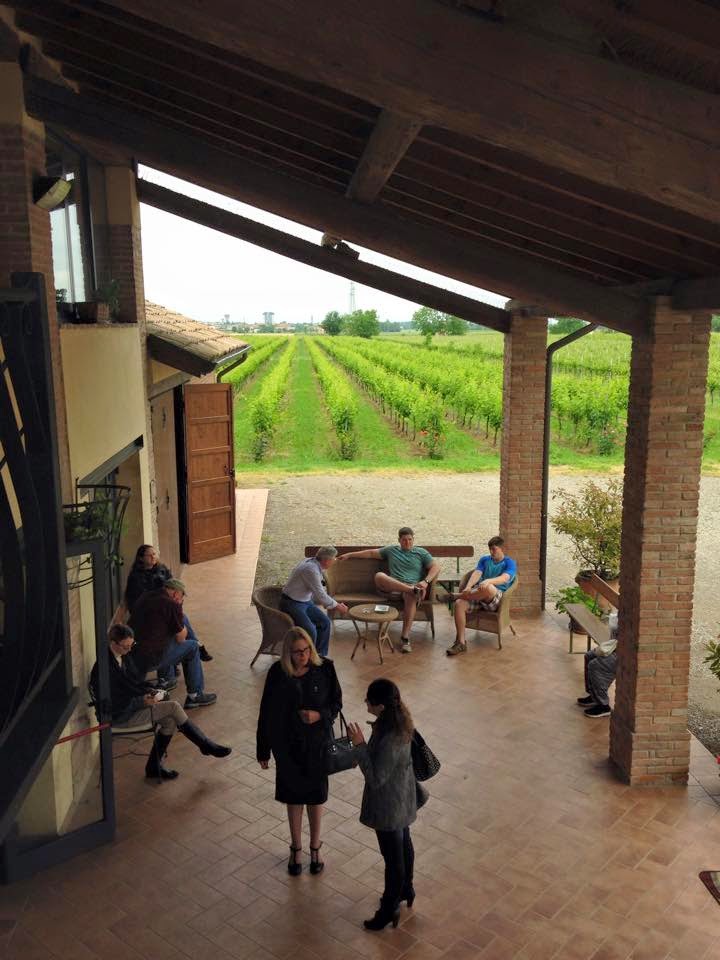
When we drove up to the Medici property (no, not those Medicis) we saw roses and grape vines. As soon as we stepped off the bus, we got a not unpleasant whiff of vinegar. We milled around for a few moments and then were brought to a courtyard where our guide explained the purpose of some of the old machinery sitting around. Most balsamic vinegar comes from trebbiano grapes, which is what the Medicis use. Other popular grapes for balsamic include Lambrusco and Spergola, and have to be grown in the region.

From the courtyard, we moved into a storage room filled with large barrels of vinegar. Here we learned each year the vinegar is moved to a smaller cask, and the yield is very small considering how much must you start off with. (Must is what is leftover after you press grapes for juice and remove the seeds and stems. They start the process by cooking the must until it reduces by a third or so.) The casks are made of various types of wood, and can include oak, juniper, mulberry, and cherry. The smell intensified as we went in this room - because each barrel is left with an opening in the top to allow evaporation, which is only covered with a piece of cheesecloth. I desperately wanted to peel back one of the cheesecloths and stick my finger in the barrel for a taste, but I resisted. Just so you know, I consider this an act of great restraint and moral superiority.


Our group then moved upstairs to two rooms with many more barrels, each of them smaller than those stored downstairs. (Ha, I almost said "belowdecks." You can take the girl off the buoytender, but she still uses nautical terminology in daily life.) Some of the casks were smaller than beer steins. Or canteloupes. Most of the aging is done in these upstairs rooms to take advantage of the temperature swings throughout the year. The fermentation process is carried out by special bacteria, and their life cycle needs temperature variations for them to thrive. We saw a barrel with a plaque on it, and the plaque was engraved with a name and year. It turns out one of the Medici family traditions is to gift a girl with barrels of her own balsamic vinegar casked on her birth year, to be used as her dowry later on when/if she gets married.


After our tour of the attic storage area, we moved to the tasting room across the way in a newer building. We each received tiny spoons and were treated to a history of balsamic vinegar-making - and we got to taste the 12-, 18-, and 25-year old vinegars. Yum yum yum! We learned that all of the traditional balsamic vinegars of the region must be packaged in specifically shaped 100ml bottles, and the only production information is not on the bottle or label, but a tag around the mouth of the bottle. This is so the vinegars can undergo a blind tasting by members of the balsamic vinegar consortium. These taste-testers check for color, flavor, viscosity, acidity, and...something else? I forget. Either way, I want that job when I grow up! Red seals denote 12-year products, silver is for vinegars aged 18 years, and gold seals top 25-year vinegars. As our guide said, vinegars can age indefinitely, a hundred years or more. The earliest known written reference to balsamic vinegar is from 1046! The best vinegars are sweet and tart and thick, and really shouldn't be wasted in salad dressings. Instead, you should put them on fresh fruit, particularly red berries; aged parmigiano cheese, or gelato. A very traditional antipasto in the region is to serve slivers of parmigiano next to prosciutto ham, and top them with a few drops of vinegar. You could also use the vinegar to enhance a steak or eggs or top off a nice soup, but those uses are less traditional. A very traditional use? As a digestif after dinner. Just a small mini-shot is all you need!

After our tasting experience, we went downstairs to the sales room. I learned Medici only produces about 1500 bottles each year, which works out to only 15 liters! I call that a labor of love. A 100ml bottle of 25-year balsamic vinegar sells for 90 euro in the Medici shop, with the 18- pricing at 65 and the 12-year coming in at 40 euro. I'm sure the prices would be even higher in the States. That was pretty steep for me, since I'm perfectly content buying the non-traditional vinegar for use in my home (and have three or four various bottles floating around), so I didn't buy any, but it was still a great experience.


Day Trip to Parma - Part 1: Cheese Factory Tour

I've had the opportunity to take a few day trips lately. (I would make a Beatles reference here, but I'm afraid of the negative connotations if I declared myself a day tripper.) My favorite cooking instructor, Lucas, has recently ventured into the world of travel trips. I've now done two of them, and today I'm writing a brief recap of our trip to Parma, which is known both for its cheese and its ham. Parmigiano and Prosciutto! What's not to love? We also went to Modena for a tour and some balsamic vinegar tasting.

Map of official Parmagiano-Reggiano region

Gotta keep it sanitary
We hopped on a bus around 0700 and were at the cheese factory well before 1000. That was the high point of my trip. Our group of about forty people donned clean paper booties, hair nets, coats, and face masks and then went up to the primary cheese-making area. All Parmigiano cheese is heavily regulated by a regulating body or consortium, and the milk must come from local cows of a certain type. It can only be produced in certain provinces: Parma, Reggio Emilia, Bologna, and Modena. Even more impressive, the cheese must be started within two hours of milking, which occurs twice a day. The evening milk is left out to start separating, and the skim milk along with whey from the day before is added to the morning milk and used for the cheese. Each vat takes 1,000 liters of milk to make each wheel of cheese. When we got there, the milk and whey mixture was already in the vats, to which rennet had been added. The milk mixture is heated - twice - and within half an hour of the second cooking a cheese ball is formed.

Heh, cheese ball.

We got to stand over a railing and watch the artisans work the cheese. Our group was with another tour group, and we all jostled for good positions at the rails so we could see what was going on. A pair of artisans used paddles and cheesecloth to lift out the cheese balls, which were then tied to a wooden board to drip dry for a few minutes. Shortly after that, the workers came back around with a knife to split the ball into two smaller pieces, which were tied off to the same wooden board. I noticed that two of the artisans looked very similar, and I turned to the lady next to me and said, "Do you think those two are brothers?" She looked at me and responded in French. Proudly resurrecting my high school french from the dregs of my memory, I said, "Sont freres?" I must have said it poorly, because she looked confused and pointed me to her tour guide. That's when I looked around and realized my tour group left me! Whoops.

Cutting the cheese, hee hee
I quickly extricated myself from the French tour group, and went back to the main hallway. My group was nowhere to be found! So I walked down another hallway, all the way to the end, and poked my head into the only open door, which was an office. So I turned around and went back to the main deck, and still, no group. I texted Lucas, and then was debating whether or not to strip off my paper clothing and go outside to the gift shop, when fortunately I saw someone open a sliding bay door. Eureka! I saw faces I recognized, and slipped into a room with wheels of cheese laying out on boards. I missed most of the guide's speech, but I gathered the cheese didn't stay in that room for very long - just long enough to get labeled with the maker's information, date, and batch number - before moving next door for brining.

Brining
Real, official Parmigiano-Reggiano cheese only has three ingredients: milk, rennet, and salt. The salt isn't added during the original cooking process; it is added during the brining phase. The wheels spend approximately one month in brining tubs before moving to the warehouse for again. I learned each wheel gets turned approximately every hour, so that it absorbs the salt evenly. The cheese rinds, by the way, are entirely edible. They are awfully hard though, which is why most people don't eat them. However, that doesn't mean they go to waste in Italian homes! The cheese rinds are often added to soups and even lasagna crusts to add a little extra umami flavor, and then removed just prior to eating.

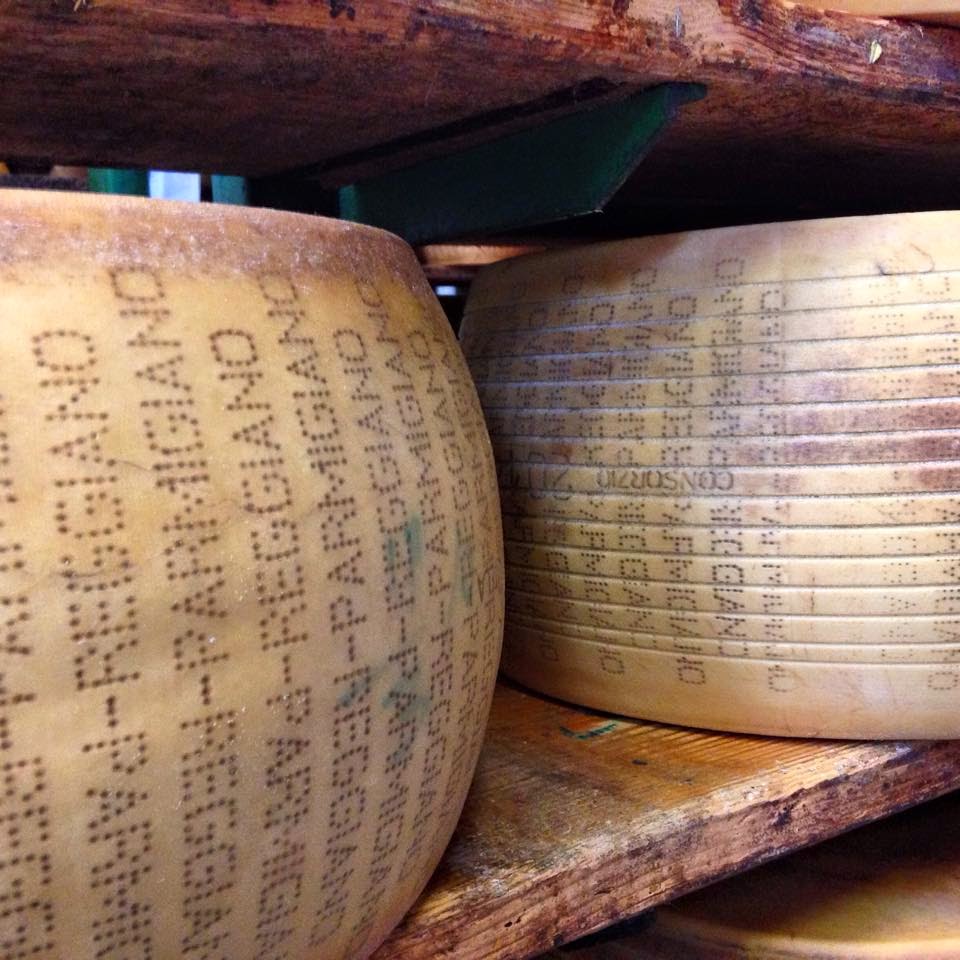
After the brining phase, the cheese wheels are brought to the warehouse for aging. Each wheel, about 35 kilograms, agest anywhere from 12-36 months. During the process, they are rotated and scraped down several times a day; there's a special forklift-looking machine specially made for going up and down the rows and flipping and scraping the cheese, to ensure they are aging evenly and staying clean. Our guide told us each wheel is worth roughly 500 Euro, and I did a quick rough count in the warehouse: 17,000 wheels of cheese, with lots of room for more! The rinds are stamped "Parmigiano-Reggiano" and dated, but they don't receive the official seal until they are just about ready for market. The cheesemakers use a very high tech tool - a hammer - to listen to the wheels. They are so practiced at this that they can determine whether a wheel has air pockets in it just by sound. Air pockets can mean the presence of bacteria, but it doesn't mean the cheese is bad. It does mean it can't be sold as official Parmigiano-Reggiano though, so those words on the label are scored through once. If after more aging there are still unexpected air pockets, the words are double-scored so that they are no longer readable. This cheese is just sold as "Italian Cheese" and though it is of a lesser quality, it is still delicious.

Left: Parmigiano-Reggiano Right: Cheese that didn't pass inspection and will be sold as lesser quality
Stacks of cheese in the warehouse next to a cheese-flipper machine
After finishing our tour of the warehouse, we went to the gift shop. I promptly purchased a cheese knife (traditionally, Parmigiano-Reggiano is cut with an almond-shaped blade), a ceramic cheese bowl, a new microplaner, and 1/2 kilo of 24-month and 1/2 kilo of 36-month cheese. When I got home that night, I made a big batch of ziti and topped it off with a mozzarella and Parmigiano-Reggiano mixture. Deeeeelicious.

I found the wikipedia page for Parmigiano Reggiano to be pretty informative, and surprisingly I retained a lot of the information our tour guide told us. I guess I pay pretty good attention when it concerns food. ;)